
An HSA employer contribution strategy is where most benefits programs either build real engagement or lose it. Two-thirds of employees with a health savings account (HSA) use it like a checking account. They spend what goes in, skip the investing, skip the retirement savings, and never fully understand what they have. The gap between what health savings accounts (HSAs) can do and how employees actually use them is an engagement problem, and it starts long before open enrollment opens.
For HR and benefits leaders managing high deductible health plans (HDHP) and HSA programs, the employer contribution strategy is the single most powerful lever available, and the right benefits technology can amplify it considerably.
Getting the contribution mechanics right, understanding the FICA tax savings, and pairing both with a smart communication strategy is what separates the employers with strong HSA engagement from those still wondering why nobody's investing.
How HSA Employer Contributions Work (And What Counts Toward the Limit)
The mechanics of HSAs are worth understanding before designing a contribution strategy.
Yes, employer contributions count toward the annual IRS HSA limit. All contributions to an employee's HSA, from the employer, the employee, or both, are pooled together and measured against the same annual cap. This applies to all deductible health plans (HDHP) paired with HSA accounts.
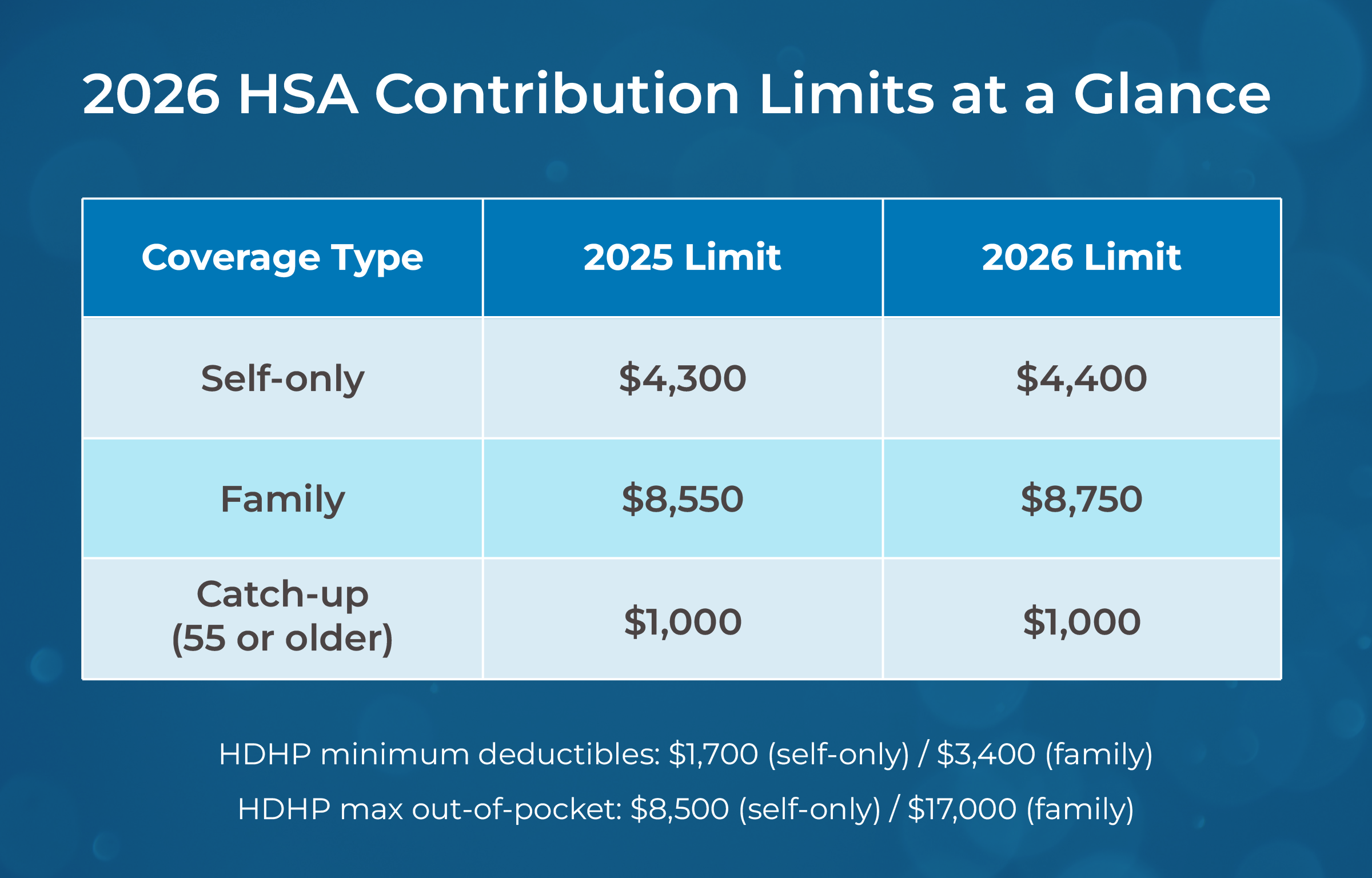
For 2026, those limits are:
- Self-only coverage: $4,400 (up from $4,300 in 2025)
- Family coverage: $8,750 (up from $8,550 in 2025)
- Catch-up contributions (55 or older): $1,000 (unchanged)
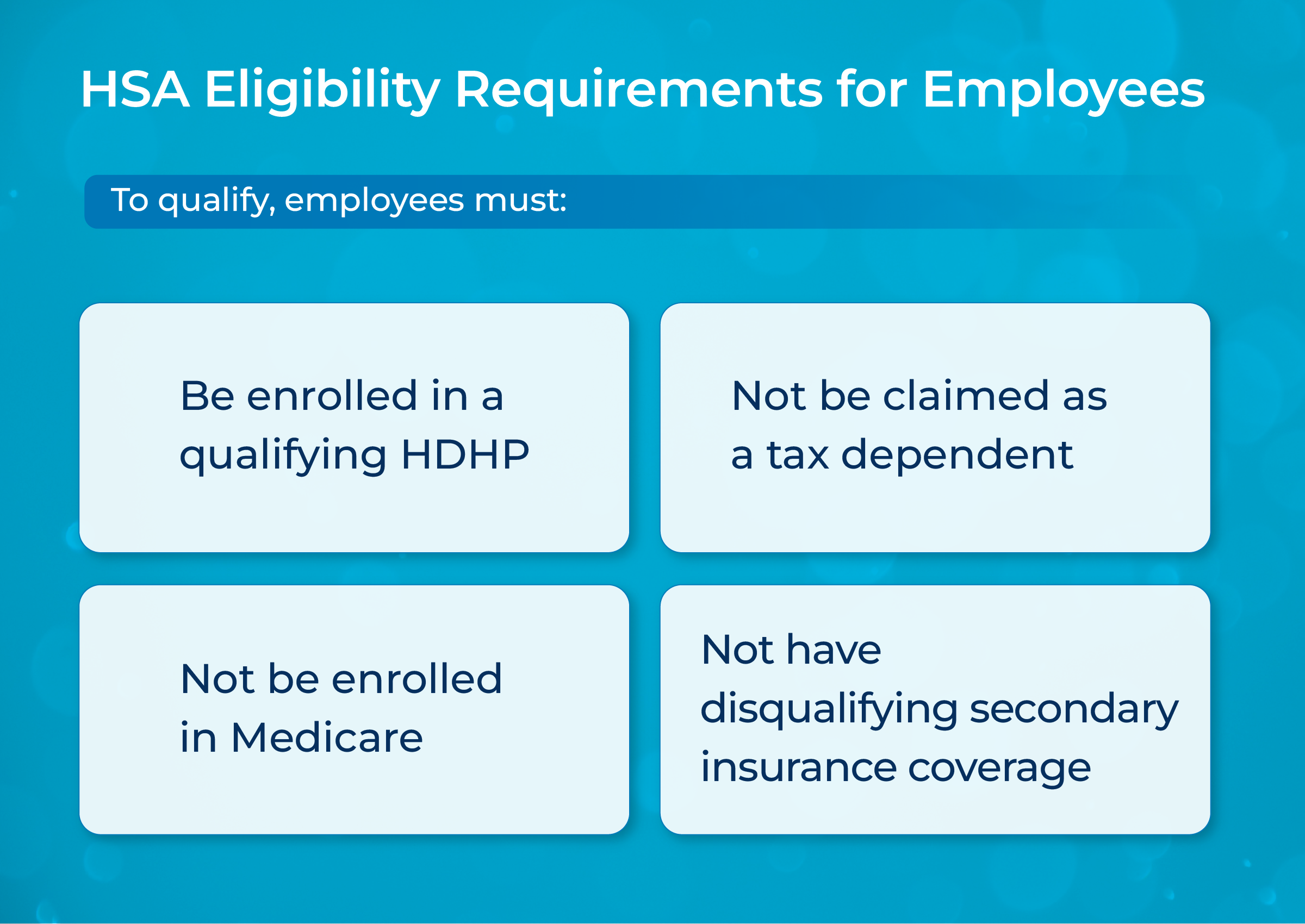
To qualify for HSA contributions, employees must be enrolled in a qualifying HDHP, not enrolled in Medicare, not claimed as a tax dependent, and not covered by disqualifying secondary insurance. The 2026 HDHP thresholds also set maximum out-of-pocket limits of $8,500 for self-only ($17,000 for family).
Employer contributions are made through a Section 125 cafeteria plan, which is where the tax advantage for employers kicks in.
The FICA Tax Savings Case for Employer HSA Contributions
HSAs offer employees a triple tax advantage. Most HR and benefits leaders know that part. The employer-side tax benefit gets less attention, and it's worth knowing.
Employer contributions to HSAs made through a Section 125 plan are exempt from FICA taxes, the 7.65% employers pay on wages. That exemption applies to every dollar contributed on behalf of an employee — on top of the federal income tax savings employees already receive on their own contributions.
Here's the math: a company with 1,000 employees, 50% HSA participation, and an average employer contribution of $1,500 saves approximately $57,375 per year in FICA taxes. That number scales directly with contribution levels and participation rates.
Only 35% of employers currently contribute to their employees' HSAs. Nearly two-thirds are leaving both the tax savings and the participation gains on the table.
How Much Should Employers Contribute? Finding the Sweet Spot
The right employer contribution isn't a single number. It varies by coverage tier and company context. But the data, drawn from 7.5 million HSA accounts, points to a clear range.
For individual coverage, the sweet spot is $750 to $1,000. For family coverage, it's $1,500 to $1,750. These ranges tend to produce the strongest participation gains without over-indexing on cost.
A few benchmarks worth knowing:
- The average employer HSA contribution is approximately $929 per account
- The Kaiser Family Foundation data puts the median at $842 for single coverage and $1,539 for family
- Even a $50 employer contribution can meaningfully increase participation; the signal matters as much as the amount
Employees interpret an employer contribution as an endorsement. It tells them the account is worth using.
Employers who fund HSAs see 11-15% increases in participation, and 83% of employees say they're more likely to work for an employer that offers HSAs. The financial wellness case and the talent case are the same case.
Why Employees Underuse HSAs (And How Technology Can Help Close the Gap)
Employees generally don't dislike HSAs. They just don't understand them well enough to use them strategically, and most HSA employee engagement programs don't give them the tools to do so. HSA adoption rates reflect this lack of understanding. Participation climbs when employers actively educate, and stalls when they don't.
Research shows that 67% of HSA owners use their accounts only for immediate out-of-pocket expenses, 28% invest their account funds, and only 35% are saving for retirement healthcare costs. Most employees are treating a powerful long-term savings vehicle like a debit card.
Two structural barriers make this worse. Many HSA custodians require a minimum account balance before allowing investment, often $1,000 or more, which keeps employees in spending mode by default. Without active employer communication and intuitive account tools, most employees never learn the full scope of what their HSA can do.
This is fixable. Decision support tools that help employees model their HDHP/HSA pairing at enrollment are a strong starting point. Employees who understand the financial tradeoffs at the moment of election are more likely to fund the account and use it correctly.
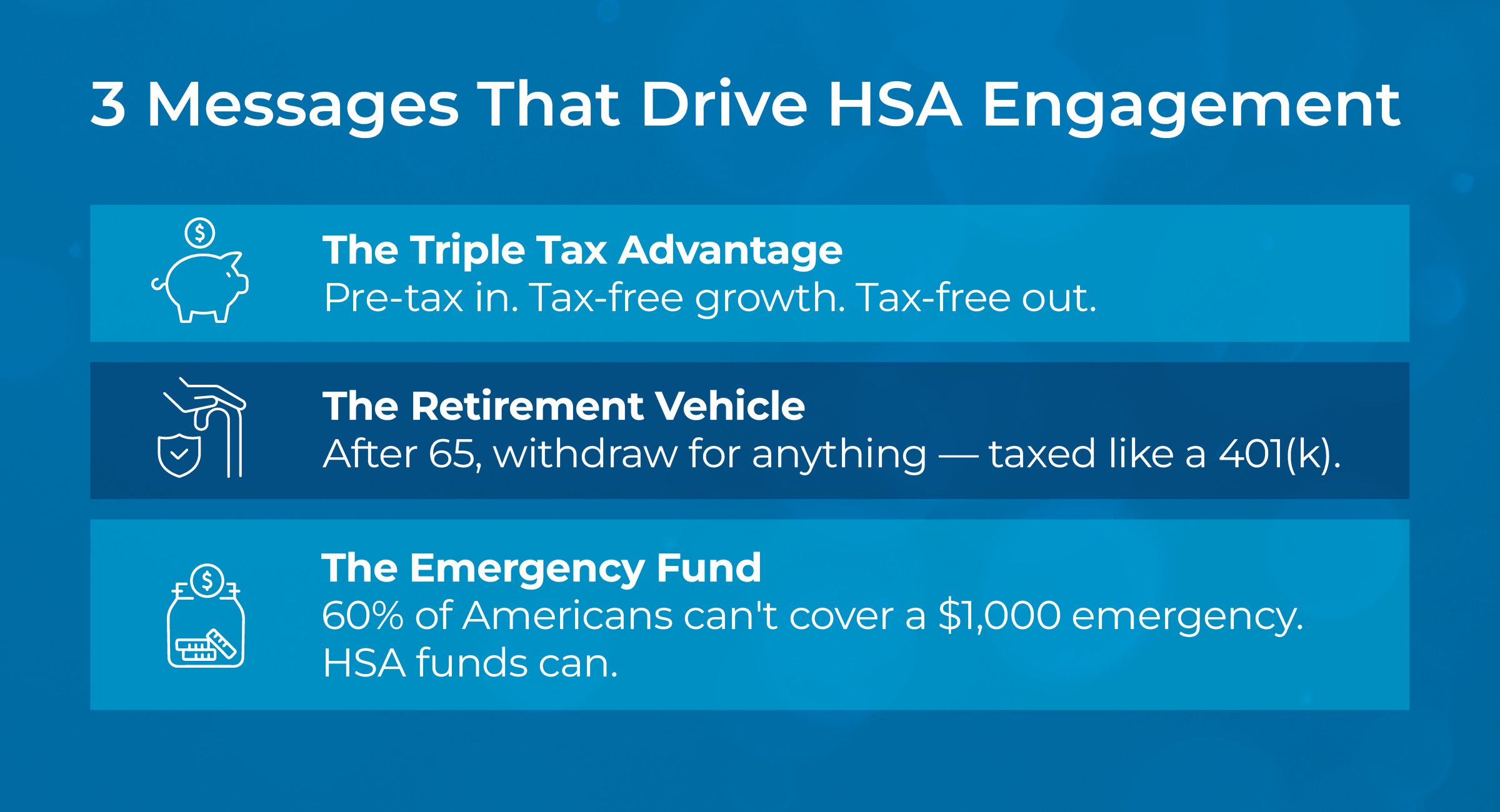
3 Communication Angles That Boost Employee HSA Engagement
There's no single message that works for every employee population. The most effective HSA employee engagement programs layer multiple angles, use technology to personalize the message by employee segment, and reinforce them year-round, not just during open enrollment.
The Triple Tax Advantage
No other savings vehicle does what an HSA does: pre-tax contributions that lower taxable income, tax-free growth on invested funds, and tax-free withdrawals for qualified medical expenses. All three, in one account.
Most employees have heard this framing but few have seen it made concrete. Show them what the tax savings look like at their income level and contribution amount. A 24% marginal rate employee contributing $3,000 saves $720 in federal income tax alone, before state taxes and FICA are factored in.
The HSA as a Retirement Vehicle
After age 65, HSA funds can be withdrawn for any purpose and are taxed like a 401(k) distribution. There are no required minimum distributions. The account can be invested in mutual funds and ETFs, making it a genuine long term financial planning tool for employees willing to treat it as one.
For higher earners who have already maxed their 401(k) and IRA contributions, the HSA is often called a "stealth IRA," an additional tax-advantaged account hiding in plain sight. This framing resonates strongly with financially engaged employees and is worth surfacing explicitly in your benefits communications for that segment.
The Emergency Fund Frame
Not every employee is thinking about retirement. For employees living paycheck to paycheck, the retirement framing can feel abstract and out of reach.
The emergency fund angle works here. Nearly 60% of Americans don't have enough savings to cover a $1,000 emergency. Medical issues—including bills and illness‑related income loss—contribute to about two‑thirds of personal bankruptcies in the U.S., according to research published in the American Journal of Public Health and summarized by Physicians for a National Health Program.
Add the 2026 IRS Limit Updates to Your Open Enrollment Materials
The IRS increases HSA contribution limits most years, and the 2026 changes are meaningful enough to communicate proactively. Building these numbers into your open enrollment materials, and messaging the increase before enrollment opens, gives employees time to adjust their contribution elections upward.
| 2025 | 2026 | |
|---|---|---|
| Self-only contribution limit | $4,300 | $4,400 |
| Family contribution limit | $8,550 | $8,750 |
| Catch-up contribution (55+) | $1,000 | $1,000 |
| HDHP min. deductible (self-only) | $1,650 | $1,700 |
| HDHP min. deductible (family) | $3,300 | $3,400 |
| HDHP max. out-of-pocket (self-only) | $8,300 | $8,500 |
| HDHP max. out-of-pocket (family) | $16,600 | $17,000 |
Tip: Send a pre-enrollment communication that highlights the new limits and reiterates your employer contribution. Employees who know the ceiling are more likely to stretch toward it, especially when they see employer dollars already in the account.
Consistent Communication Creates Value for Employers and Employees
The employers with the highest HSA engagement rates fund the account, educate employees, and stay in the conversation year-round, using personalized benefits technology to get the right message to the right employee at the right time. Generous contributions help. Consistent communication is what actually moves behavior.
To see how benefits technology can support HSA education, enrollment, and year-round expense management for your employees, request a demo.