
Your company spends somewhere between 20 and 30 percent of total payroll on employee benefits every year. For a $50M-payroll company, that’s $10–15 million invested in healthcare coverage, retirement matching, wellness programs, and voluntary offerings. Then open enrollment closes — and a significant share of that investment produces no return.
The problem isn't the benefits. It's utilization. Employees enroll, then don't use what they signed up for. They forfeit FSA funds. They ignore EAP services. They never schedule the dental cleaning their plan fully covers. Even if they do use them, they might not use them as well as they could. They go to an ER instead of urgent care. Or they go out of network for care that could be handled by a preferred provider.
And most HR teams don't realize how widespread it is until they start pulling the data.
This guide covers how to measure where your gaps are, what's driving them, and what changes actually move utilization numbers for mid-to-large employers.
What Is Benefits Utilization — and How Do You Measure It?
Benefits utilization is the rate at which eligible employees actively use a benefit — not just enroll in it. The formula is simple: number of employees using a benefit ÷ total eligible × 100. From there, organizations can go deeper by understanding when and how they are using their benefits and what they value the most about the benefits experience.
That distinction matters more than most organizations track. Enrollment captures intent. Utilization captures behavior and outcomes. An employee who signs up for an FSA (flexible spending account) during open enrollment but forfeits funds at year-end has enrolled but not utilized. These are different problems with different solutions.
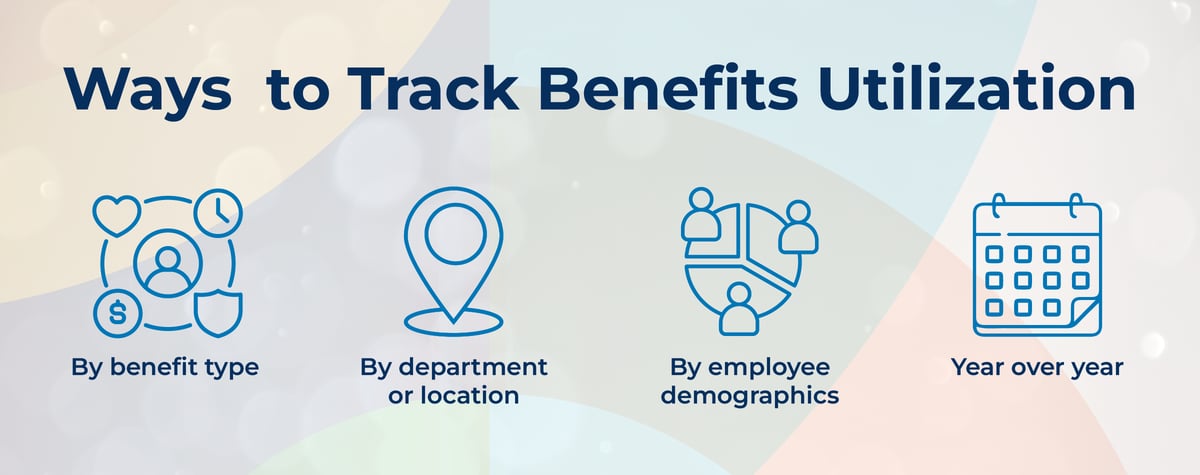
To diagnose where your gaps are, track utilization across several dimensions:
- By benefit type — health, dental, vision, EAP, FSA/HSA, 401(k), tuition reimbursement, wellness programs
- By department or location — gaps often cluster around specific populations
- By employee demographics — life stage and family status drive benefit relevance
- Year over year — trends reveal whether your communication and education efforts are working
A single utilization rate tells you very little. A diagnostic view tells you where employees aren’t being reached — and why.
The Cost of Underutilization
Start with the math. Benefits typically represent 20–30% of total payroll. When employees don’t engage, a meaningful portion of that spend produces no return — no retention lift, no wellbeing improvement, no ROI on the programs HR built.
Retention compounds the stakes. Employees are significantly more likely to stay with employers offering comprehensive, personalized benefits — but only when those benefits actually work for them. Low utilization means the retention value isn’t landing.
The most counterintuitive finding in this space is what researchers call the wellbeing paradox: the employees who most need benefits — those struggling financially, physically, or emotionally — are often the least likely to access them. At that point, utilization becomes an equity issue as much as an ROI one.
Utilization Benchmarks by Benefit Type
Before you can improve utilization, you need to know where your numbers stand. The table below offers a starting diagnostic based on current industry research. Your own population and plan design will affect where you land.
| Benefit Type | Typical Utilization Rate |
|---|---|
| 401(k) / Retirement | 75–83% |
| Health Insurance / Medical | 61–66% |
| Wellness programs | ~40% |
| Mental health / EAP | 5–23% |
| Tuition reimbursement | 3–5% |
| Adoption assistance | ~1% |
A few numbers deserve extra attention.
The FSA problem is largely invisible: roughly 47% of enrolled employees forfeit funds annually. They enrolled, set money aside, and never used it — a communication failure that’s entirely preventable.
The HSA contrast tells a more useful story. HSA participation sits around 15% without meaningful employee education and jumps to 44% when employees receive genuine guidance on how the account works. That gap isn’t a product problem — it’s a benefits communication problem. The fix exists. Most employers just haven’t applied it consistently.
EAP utilization at 5–7%, despite the near-universal availability of mental health support, reflects something harder to fix through platform design alone: stigma, low awareness, and eroded trust. Year-round visibility and manager training can move the number, but only when they address the actual barrier.
Why Employees Don’t Use Their Benefits
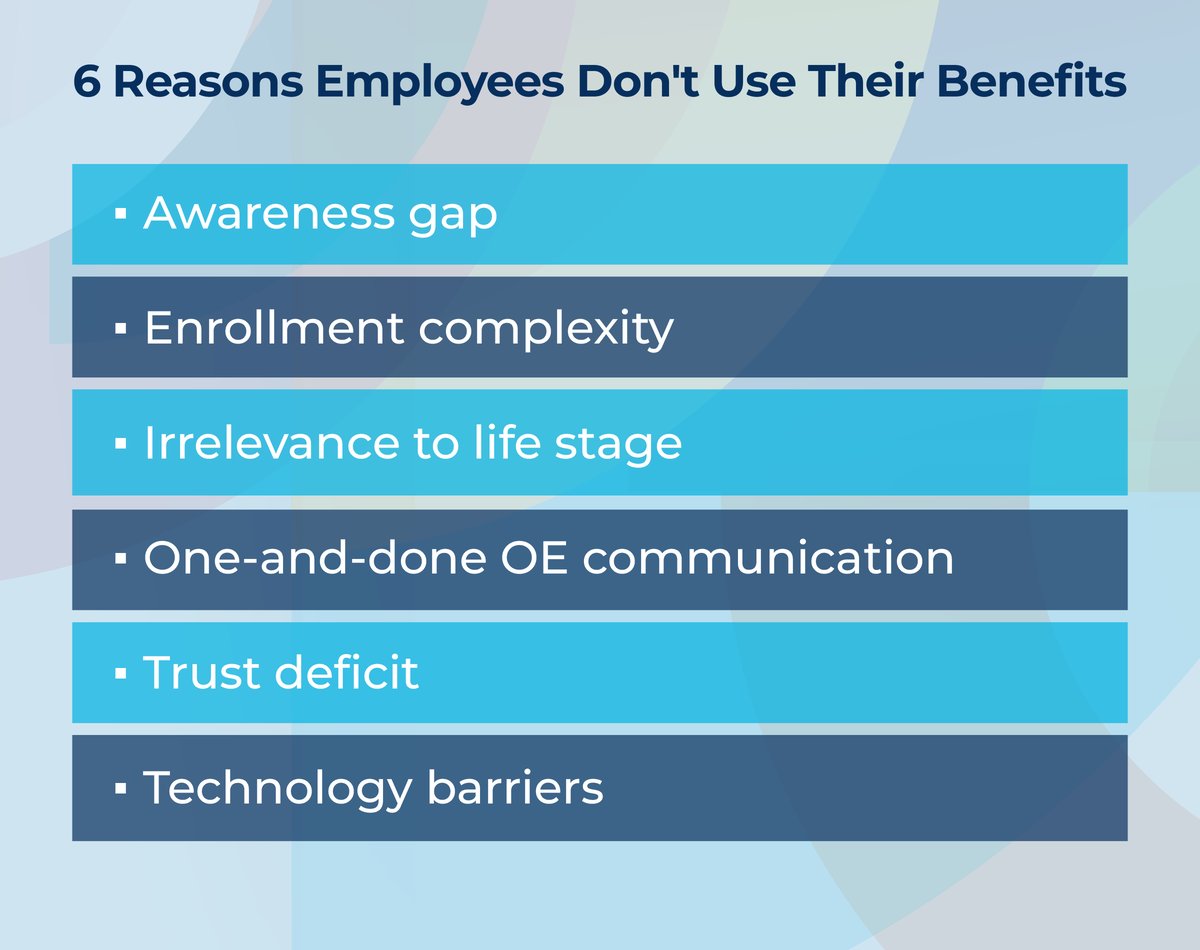
Low utilization is rarely one thing. Six root causes show up consistently across organizations of every size.
Awareness gap. Employees don’t know a benefit exists, don’t remember enrolling, or can’t recall how to access it. According to NFP’s 2026 Benefits Trend Report, 13% of employees forget they have certain supplemental benefits — despite employers expanding their benefit menus significantly since the pandemic.
Enrollment complexity. When understanding or accessing a benefit requires effort — multiple logins, confusing plan comparisons, unclear instructions — employees disengage. Friction is a utilization killer.
Irrelevance to life stage. A 24-year-old with no dependents may see little value in dependent care FSAs or life insurance riders. Benefits that don’t connect to where someone is in their life get ignored.
One-and-done open enrollment communication. When benefit education only happens at OE, employees make decisions without full context and have no ongoing touchpoint to remind them what they have when they actually need it.
Trust deficit. Employees — particularly those already stressed — may be skeptical that EAP services are confidential, that FSA funds are secure, or that employer guidance reflects their interests. Poor employee understanding of how benefits work compounds this.
Technology barriers. Fragmented benefit platforms, poor mobile experiences, and multiple vendor portals create friction that drives disengagement — especially among hourly and frontline workers who don’t spend their day at a desk.
5 Strategies to Improve Benefits Utilization
Improving utilization requires more than a better open enrollment microsite. It takes a deliberate, year-round approach to how employees understand, access, and engage with what they’ve been given.
1. Communicate Year-Round
Open enrollment is one touchpoint. Utilization requires twelve. When employees only hear about their benefits during the annual window, they make decisions without context and have no mechanism to act when circumstances change.
Year-round communication keeps benefits top of mind by reaching employees at the moments that matter: adding a dependent, navigating a health event, hitting FSA deadlines, starting a new role. Multi-channel delivery — mobile push notifications, email, manager briefings, on-demand resources — meets employees where they are. The connected benefits experience starts with consistent presence, not annual announcements.
2. Personalize the Decision-Support Experience
Generic communications treat every employee the same. Personalized decision support treats employees as individuals with specific health histories, family situations, and financial priorities.
At enrollment, AI-powered recommendation tools can match employees to plans and accounts most likely to benefit them — closing the knowledge gap before it becomes a utilization gap. Decision support tools built around genuine recommendation logic do something a PDF guide can’t: they help employees make choices they actually stick with, which means higher retention of coverage year over year.
3. Build a Benefits Education Program, Not a One-Time Event
On-demand video, interactive guides, and plain-language explainers available when employees actually need them address utilization gaps that OE-only education never reaches.
Onboarding is an underused first utilization touchpoint. New hires are actively trying to make sense of their new environment — a structured benefits education component at 30, 60, and 90 days ensures employees understand what they have before they need it. Year-round benefits education resources give employees somewhere to go when their needs change, and they will.
4. Simplify the Experience
Complexity is a utilization tax. A more robust benefits offering without better support doesn’t improve engagement — it creates more confusion.
Simplification means fewer required steps, mobile-first access for employees who aren’t at desks, and a single-platform experience rather than a fragmented vendor ecosystem. When an employee can find what they need in under two minutes, they’re far more likely to use it.
5. Track the Numbers and Adjust
Utilization improvement is an ongoing practice, not a one-time campaign. The organizations that make real progress track the right metrics, learn from them, and adjust.
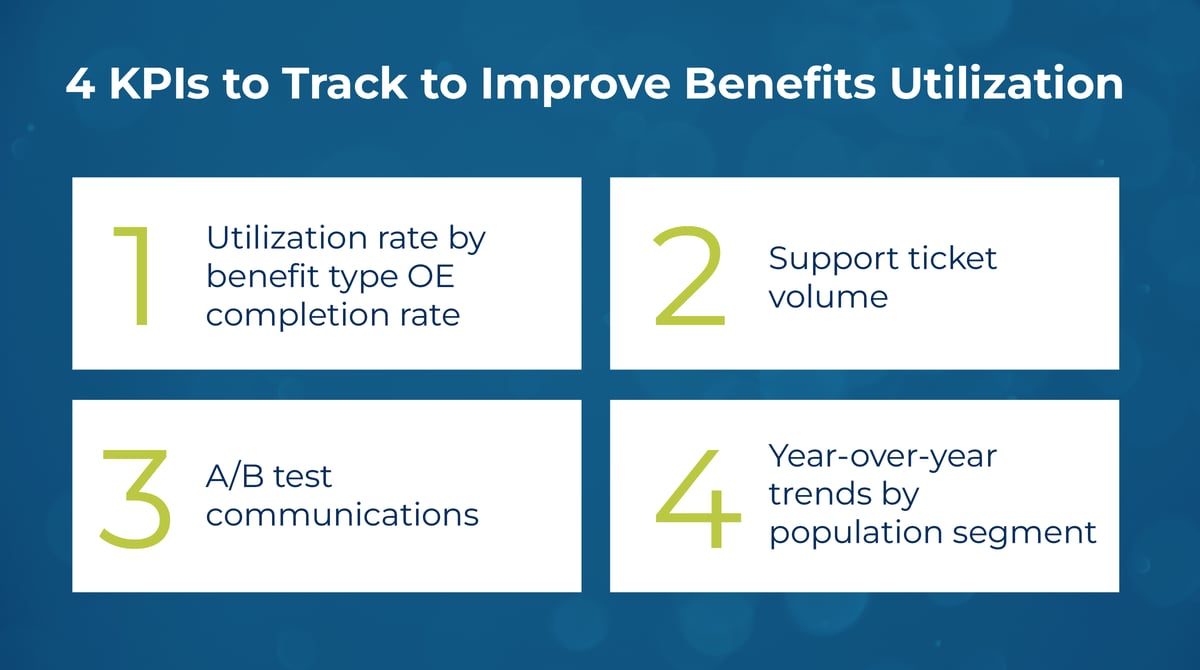
Core metrics to monitor: utilization rate by benefit type, OE completion rate, year-over-year trends by population segment, and inbound support ticket volume — an early signal of navigation or clarity problems before they show up in the data. A/B testing communications — subject lines, delivery timing, message framing — produces actionable evidence about what actually moves employee behavior. The benchmarks above are a starting point. Your own trend line is the real diagnostic.
Start Where the Gap Is Biggest
Most employers have built something worth using. The problem is that employees don’t know it, can’t find it, or gave up trying. The organizations that close the utilization gap do it with data, personalization, and year-round engagement — and the results show up in retention, wellbeing, and the ROI on every dollar that went into that benefits package.
If you’re ready to see what that looks like in practice, request a demo to explore how Empyrean’s engagement and communications tools help employers turn enrollment into utilization.
FAQ
What is a good benefits utilization rate? It depends on the benefit. Health coverage typically lands in the 61–66% range, while retirement plans reach 75–83%, especially when automatic enrollment is in place. Wellness programs average around 40%, and EAP utilization typically runs 5–7%. The more useful benchmark is your own year-over-year trend.
What’s the difference between benefits enrollment and benefits utilization? Enrollment measures whether an eligible employee signed up for a benefit. Utilization measures whether they actually used it. An employee can be enrolled in a dental plan and never schedule a cleaning, or signed up for an FSA and never submit a claim. Tracking only enrollment significantly overstates how well your benefits program is working.
Which employee benefits have the lowest utilization rates? EAP consistently ranks among the lowest, typically 5–7% despite near-universal availability. Tuition reimbursement (3–5%), adoption assistance (~1%), and FSAs — where roughly 47% of enrolled employees forfeit funds annually — are all chronically underused, each for different reasons.
How does benefits communication affect utilization? Directly and significantly. HSA participation sits at 15% without meaningful education and jumps to 44% when employees receive genuine guidance. That gap is almost entirely a communication story. Employees who don’t understand what a benefit does, when to use it, or how to access it won’t use it. Year-round, personalized communication is one of the highest-leverage tools available for improving benefits engagement.
What technology helps improve employee benefits utilization? Platforms that consolidate enrollment, communications, and decision support in a single experience reduce friction and increase engagement. Mobile-first access is particularly important for reaching hourly and frontline workers. AI-powered decision support tools that personalize plan recommendations at enrollment help employees make better choices from the start — which is where utilization either begins or stalls.