
Ask any benefits manager what HR needs from AI in their day-to-day work, and the answer is rarely “more dashboards.” Yet that’s mostly what artificial intelligence AI has delivered so far: more data, more reports, more features with impressive names but underwhelming follow-through.
The gap between what the technology promises and what it delivers isn’t necessarily shrinking as more vendors race to bolt generative AI features onto existing platforms, and HR leaders are running out of patience for it. They’re looking for ways to resolve issues faster and reduce the rate of enrollment errors.
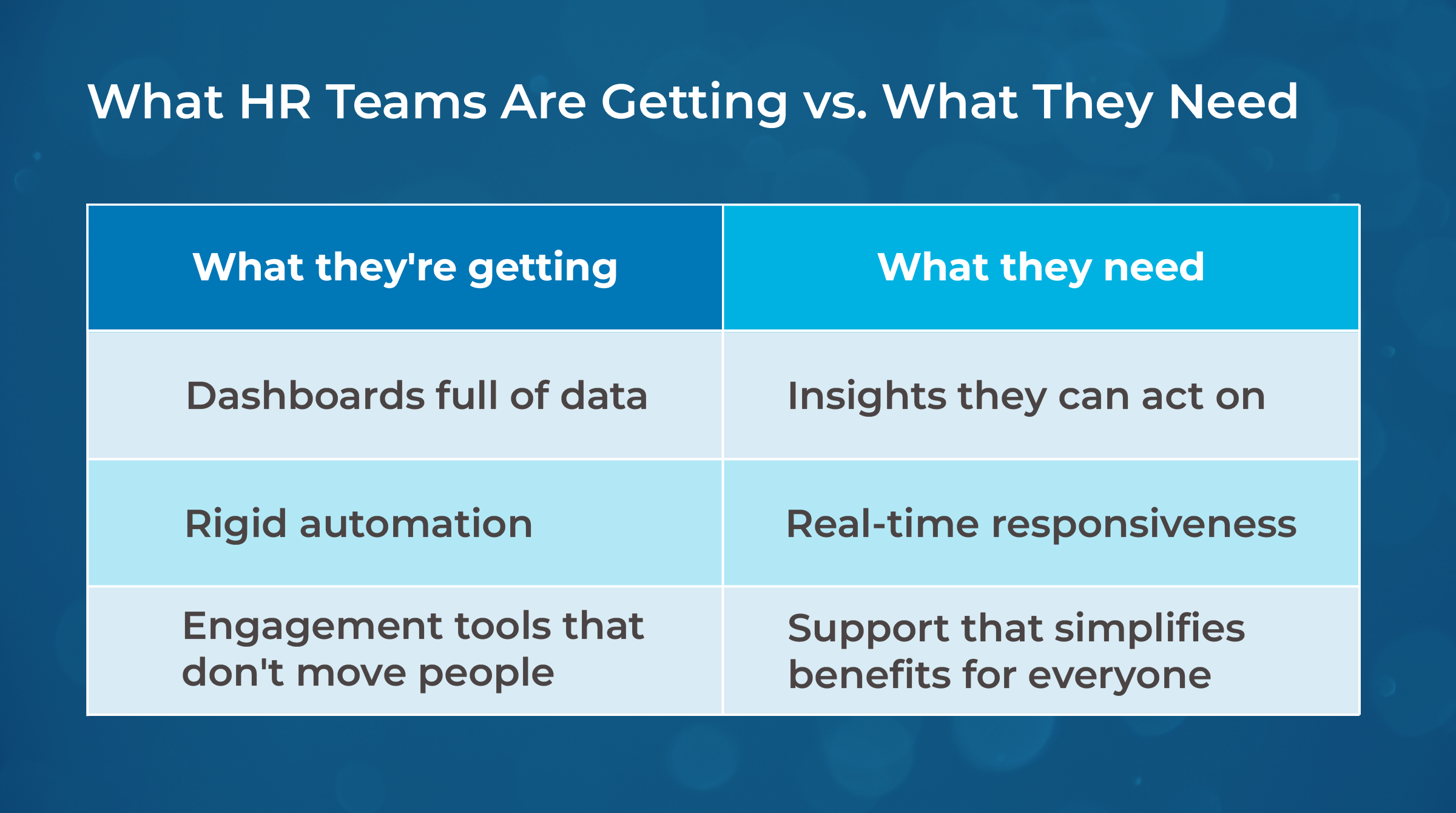
What they actually need from AI and benefits is insights they can act on, real-time responsiveness, and support that makes the experience simpler for employees and administrators alike. What they’re getting, on most platforms, are dashboards full of data with no strategic guidance, automation with no human safety net, and engagement tools that don’t move people. The differentiator, when evaluating any vendor, isn’t whether they have AI. It’s where the AI is applied and how it’s governed.
Where AI in Benefits Actually Has to Deliver
Four capability areas define whether AI adoption in benefits is genuinely useful or just impressive on paper. Most platforms struggle with at least two of them.
Helping Employees Navigate Benefits in the Moment
The way most employees interact with their benefits today is transactional at best and frustrating at worst. They log in during open enrollment, make selections without fully understanding them, and don’t hear much until the following year. When something happens in between, whether a new diagnosis, a prescription they can’t afford, or a life event that changes their coverage needs, they’re largely on their own.
AI has the potential to change that by making benefits interactions feel natural rather than administrative. Natural language processing has made virtual assistants significantly more capable, and when those tools are deeply embedded into the benefits experience rather than bolted on as a separate chat window, employees can get to the right information faster and take action at the moment they actually need to. The goal is a conversational benefits experience that guides employees directly to what they need, whether that’s understanding a plan option, finding an in-network provider, or figuring out what they’re actually covered for after an accident.
The platforms that get this right don’t treat using AI as the goal. They treat it as part of a toolkit that helps people reach a better resolution.
Turning Data Into Decisions That Actually Help Employees
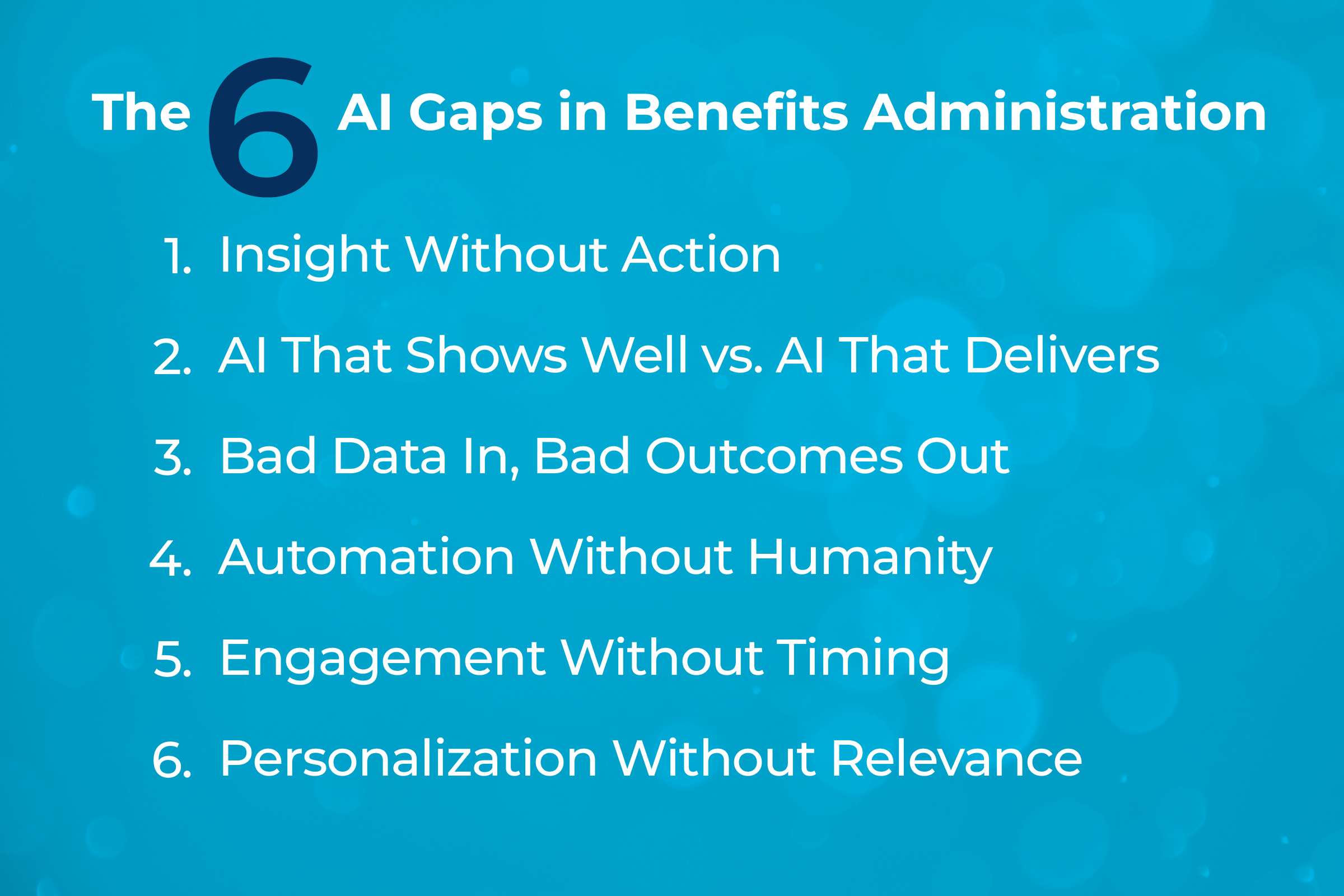
Many AI systems surface data but stop short of telling anyone what to do with it, which is exactly the wrong place to stop. A spike in FSA underutilization or a dip in preventive care engagement means something, but without context and direction it’s just another number on a dashboard nobody has time to interpret.
AI can process large volumes of employee data in real time, and when it’s working well it gives HR the grounding to make an informed decision quickly rather than reacting after the fact. But that only works if the platform closes the loop between data and decision. Most aren’t built that way, and the gap between “we have the data” and “we know what to do about it” is where benefits programs lose momentum.
The same problem shows up at the employee level. Autofilling a first name in a mass email is not personalization, and HR leaders have known that for years. What they actually want are AI tools that factor in an employee’s life stage, job role, benefit utilization history, and health data, then use that to drive communications that prompt action that makes sense for that person specifically.
AI algorithms can surface the right benefit option for the right person at the right moment through predictive analytics and real-time insights, but only when they’re trained on accurate employee data and designed to do more than segment by age bracket. When it works, benefit suggestions are grounded in participant preferences, health claims, and financially optimal actions: guiding a younger employee toward HSA investment strategies, or flagging a supplemental payout available after a recent accident.
Making Sure Human Support Is There When It Matters
Automating tasks is something AI does reasonably well, but expecting that automation to support employees who are stressed, confused, or dealing with something serious is a different problem entirely. A SHRM report found that 35% of organizations feel AI lacks the human touch, and in benefits, where the stakes of a wrong answer are real, that’s not a minor complaint. People grappling with benefits questions during a health crisis or a major life change don’t want to be routed through a chatbot maze with no way out.
The answer isn’t less AI. It’s AI designed with a clear handoff to humans. When AI-powered assistance connects directly to live experts, saving time without removing the human element, employees get quick answers and can reach a person when they need one without starting over.
Service teams get context and sentiment signals that help them resolve issues faster and more consistently. That combination is a support model, not just a chatbot, and the difference matters when an employee is trying to understand a denial or add a dependent after a qualifying life event.
Keeping the Underlying Data Clean Enough to Trust
AI is only as good as the data it runs on, and that’s the part that rarely makes it into vendor pitches. When employee data is stale, enrollment records are inconsistent, or carrier feeds contain errors, even a sophisticated AI model produces flawed results. Human error in data entry and integration compounds quickly in automated systems, and bad outputs from a trusted platform erode confidence in HR in ways that are slow to rebuild.
Data governance isn’t a back-office IT problem. It’s the foundation that determines whether AI-powered guidance is useful or actively misleading, and any serious evaluation of a benefits platform has to include it.
The right approach runs AI-driven automation and validation throughout the administrative process, increasing efficiency and keeping benefits data accurate as employee needs and program details shift. That means flagging anomalies and surfacing compliance risks before they become problems, so the intelligence HR teams are acting on is actually reliable.
What Good AI in Benefits Looks Like in Action
The employers who get the most from AI in benefits tend to ask harder questions before they commit than the ones who get burned by it. AI is a powerful tool when the intelligence lives inside the processes where it matters, but evaluating that requires more than watching a demo. Where does the intelligence actually live in this platform? How is the underlying data governed? What outcomes have other clients seen?
At Empyrean, we call the answer to those questions benefits activation, helping employees take the right action at the right time while giving HR leaders clarity and control over how their benefits perform. Empyrean’s AI connects benefits data, digital interactions, and service expertise across every touchpoint, every day of the year, built into the operating layer rather than sitting on top of it. To see how that works in practice, let’s talk.