
Ask an HR or benefits leader why they haven't pursued benefits administration outsourcing, and you'll hear many of the same answers: it's too expensive, our plans are too complicated, we'll lose control, and employees will suffer.
These issues reflect real pain points, often based on poor experiences with outsourcing in the past. These benefits outsourcing myths can also lead organizations to stick with ineffective strategies even when the status quo is clearly costing them.
Core benefits administration services have changed substantially in pricing flexibility, platform sophistication, service delivery, and the degree of control benefits teams actually retain, though. The assumptions organizations used to have about outsourcing haven't kept pace with how outsourcing has changed.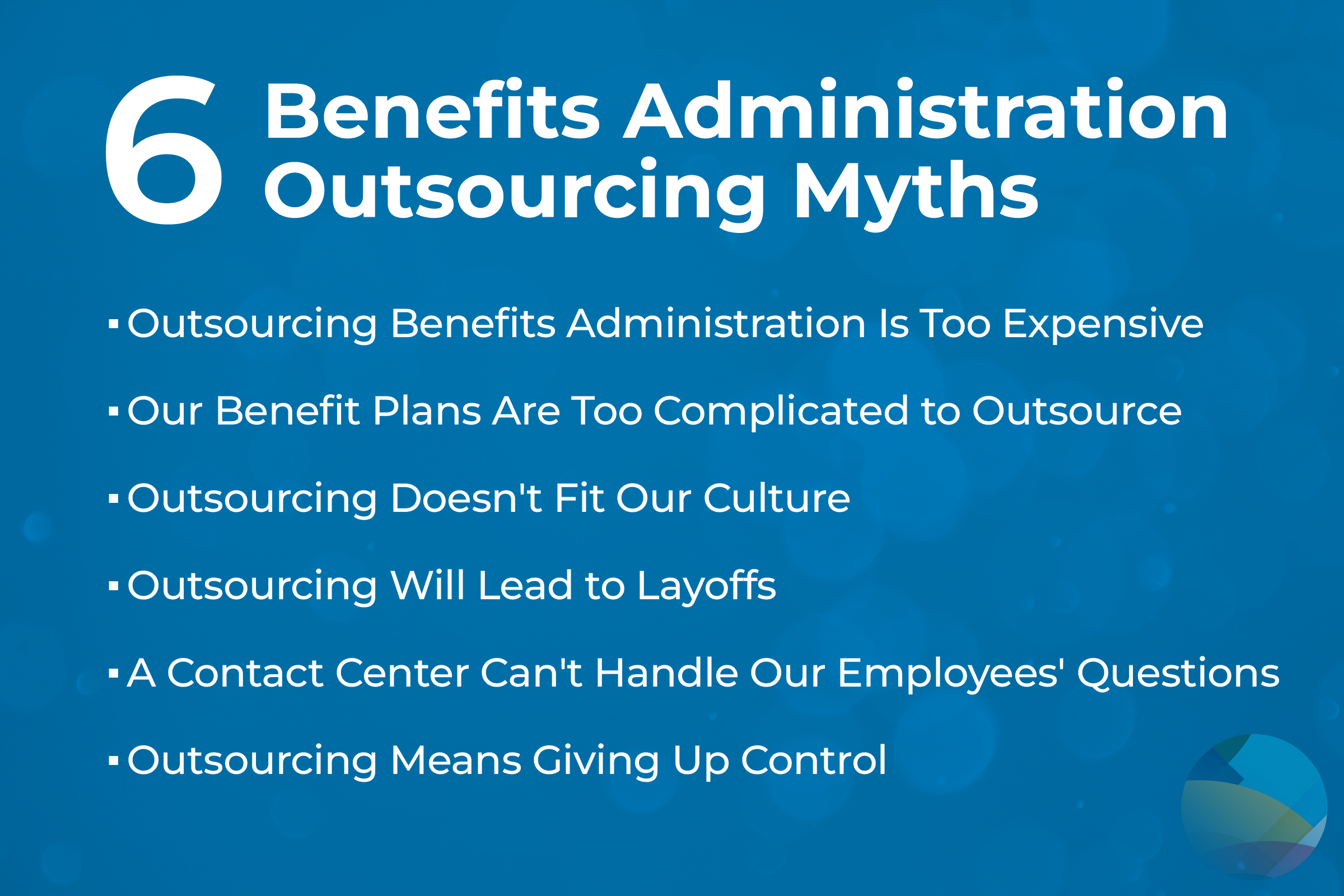
Myth #1: Outsourcing Benefits Administration Is Too Expensive
The Myth
Outsourcing adds a line item on top of what you're already spending, and the budget simply isn't there.
The Reality
The more useful question is whether the total cost of managing benefits in-house is actually as low as it appears. When you account for staff time, technology investment, compliance risk, and the cost of errors including audit penalties, corrective filings, and missed deadlines, the in-house model often costs more than benefits teams realize.
Most providers have moved away from one-size-fits-all pricing, with outsourcing services designed for businesses of all sizes. Unbundled models let you outsource only the functions that fit your budget and complexity. It's also worth knowing how widely this has already been adopted:employers now outsource roughly 40% of their benefits functions on average, with COBRA, FSAs, and pharmacy benefits exceeding 75% outsourcing rates. That’s a signal that the service model has matured well past the early days that gave rise to these concerns.
Outsourcing isn't necessarily a budget problem. For many organizations, it's actually a cost savings solution.
Myth #2: Our Benefit Plans Are Too Complicated to Outsource
The Myth
Years of accumulated complexity, unique eligibility rules, legacy employee populations, and customized plan structures mean no outside vendor could manage all that nuance without something falling through the cracks.
The Reality
Modern benefits administration platforms are built precisely for this kind of complexity. Rules-based engines organize workforces into the right eligibility groups automatically, applying the correct benefits logic to each population and helping to reduce manual errors and intervention. What looks like an impossible tangle of exceptions often becomes manageable and auditable once it's mapped into a well-configured system.
AI has accelerated this considerably. Today's platforms use machine learning to surface eligibility anomalies, flag compliance risks before they become problems, and deliver personalized decision support to employees based on their individual circumstances without requiring benefits teams to manually manage any of it. The more complex your benefit offerings, the more leverage AI-driven administration actually gives you.
There's a secondary benefit worth noting. The transition to an outsourcing partner typically prompts a thorough review of existing administrative processes against industry best practices. For many benefits teams, that review surfaces inefficiencies that had been invisible for years.
Myth #3: Outsourcing Doesn't Fit Our Culture
The Myth
A third-party vendor won't understand your workforce, won't reflect your values, and will deliver a generic experience that erodes employee trust in benefits.
The Reality
Cultural fit is a legitimate concern, and the right provider will treat it as one. Strong implementation processes include a deliberate cultural immersion component: Structured discovery sessions, cross-functional workshops, and on-site engagement that give the provider a genuine understanding of your workforce and what your employees expect from their benefits experience.
For organizations that want to maintain more direct control over employee-facing services, co-sourcing is a well-established middle path. Administrative functions like enrollment processing, compliance management, and carrier data feeds move to the provider, while call center or other direct employee interactions stay in-house. Understanding the full range ofoutsourcing models available is the first step toward finding an approach that fits.
Myth #4: Outsourcing Will Lead to Layoffs
The Myth
When an outside vendor takes over benefits administration, internal human resources jobs disappear along with the work.
The Reality
Outsourcing is a partnership model, not a turnkey replacement. Benefits teams still own the strategy, manage the vendor relationship, and serve as the connective tissue between the provider and the organization. What changes is where that expertise gets directed.
Benefits administration is among the most time-consuming work a benefits team carries, and most of that time goes to administrative tasks like processing enrollments, managing eligibility changes, fielding routine questions, staying current on compliance requirements. Outsourcing reclaims that time. Benefits leaders who make this move consistently report that it frees them to focus on plan design, vendor strategy, employee communication, and the work that actually shapes employee outcomes.
The goal is a more effective benefits team, not necessarily a smaller one.
Myth #5: A Contact Center Can't Handle Our Employees' Questions
The Myth
An employee with a benefits question gets routed into a generic e-mail or phone queue, reaches someone who doesn't know the plan, and walks away frustrated.
The Reality
That experience is the result of a bad vendor, not an inherent feature of outsourcing. Theservice model behind a provider often matters more than the technology, and the best providers assign dedicated teams to specific client accounts. Those representatives are trained on your specific benefit offerings, your population, and your communication expectations, helping employees understand their options clearly and confidently. They become experts on your benefits program, not generalists reading from a script.
The infrastructure behind these teams is also meaningfully stronger than most in-house alternatives: sophisticated call tracking, decision support tools, and resource libraries that allow reps to handle customer service interactions accurately and consistently. For many employees, the service experience from a well-run outsourced team is better than what they had before.
Employee experience is one of the strongest arguments for outsourcing, not a reason to avoid it.
Myth #6: Outsourcing Means Giving Up Control
The Myth
Once administration is in someone else's hands, the benefits team loses visibility, flexibility and the ability to course-correct when something goes wrong.
The Reality
Modern benefits outsourcing platforms give benefits leaders more visibility into their programs than most in-house systems can deliver. Real-time reporting, eligibility auditing, and compliance tracking are standard features of mature outsourcing relationships, and they typically surface insights that manual processes miss entirely.
Flexibility is also built into how leading providers structure their engagements. Full outsourcing, co-sourcing, and insourcing all remain viable options, and the right partner doesn't force a single model. As needs evolve with new acquisitions, workforce changes, or regulatory shifts, a good provider adapts alongside you. What you're outsourcing is the execution. Benefits leaders still direct the strategy.
The distinction matters: Outsourcing the execution while retaining strategic direction is what aconnected benefits experience is actually built on.
The Right Partner Changes the Equation
These common myths about benefits outsourcing share a common thread: They assume the worst about what an outside partner can deliver. The reality is that outsourcing has matured considerably, and providers who have earned long-term client relationships have done so by proving those assumptions wrong on cost, complexity, culture, and service.
For benefits leaders carrying more than their teams can reasonably manage, the more useful question isn't whether outsourcing is right in principle. It's whether the right partner exists for your organization's specific needs.
If you're ready to explore what that looks like, connect with an Empyrean expert to start the conversation.