
The week after open enrollment closes, many HR and benefits leaders find themselves doing the same thing: playing catch up. They’re chasing down missing elections, correcting eligibility errors, and reconciling carrier data that doesn't match what's in the system.
None of that is why they got into HR or benefits.
Benefits administration is one of the most consequential things an employer does for its people. It’s also one of the most time consuming for the teams responsible for it. As programs grow more complex and regulatory requirements more demanding, a growing number of employers are asking a reasonable question: Does this have to live entirely in-house?
HR teams that outsource benefits administration aren't giving something up. They're making a deliberate call about where their judgment is most valuable — and deciding that eligibility reconciliation isn't it.
What Is Benefits Administration Outsourcing?
Benefits administration outsourcing means choosing to outsource employee benefits to a third-party provider to handle some or all of the operational work behind your program. The outsourcing provider doesn't replace your HR team. Instead, it works alongside it, taking on the execution so your staff can focus on the work that requires judgment, relationships, and strategy.
Depending on the scope, that can include:
- Enrollment management and eligibility processing
- ACA (Affordable Care Act) reporting and compliance
- Carrier data feeds and reconciliation
- FSA (Flexible Spending Account) and HSA (Health Savings Account) account management
- COBRA (Consolidated Omnibus Budget Reconciliation Act) administration
- Employee communications and service center support
- Payroll deductions and premium reconciliation
Most conversations treat this as a binary choice. They either handle it in-house or hand it off. In practice, there are actually three distinct models, and many organizations land somewhere between the extremes.
3 Models: Full Outsourcing, Co-Sourcing, and Insourcing
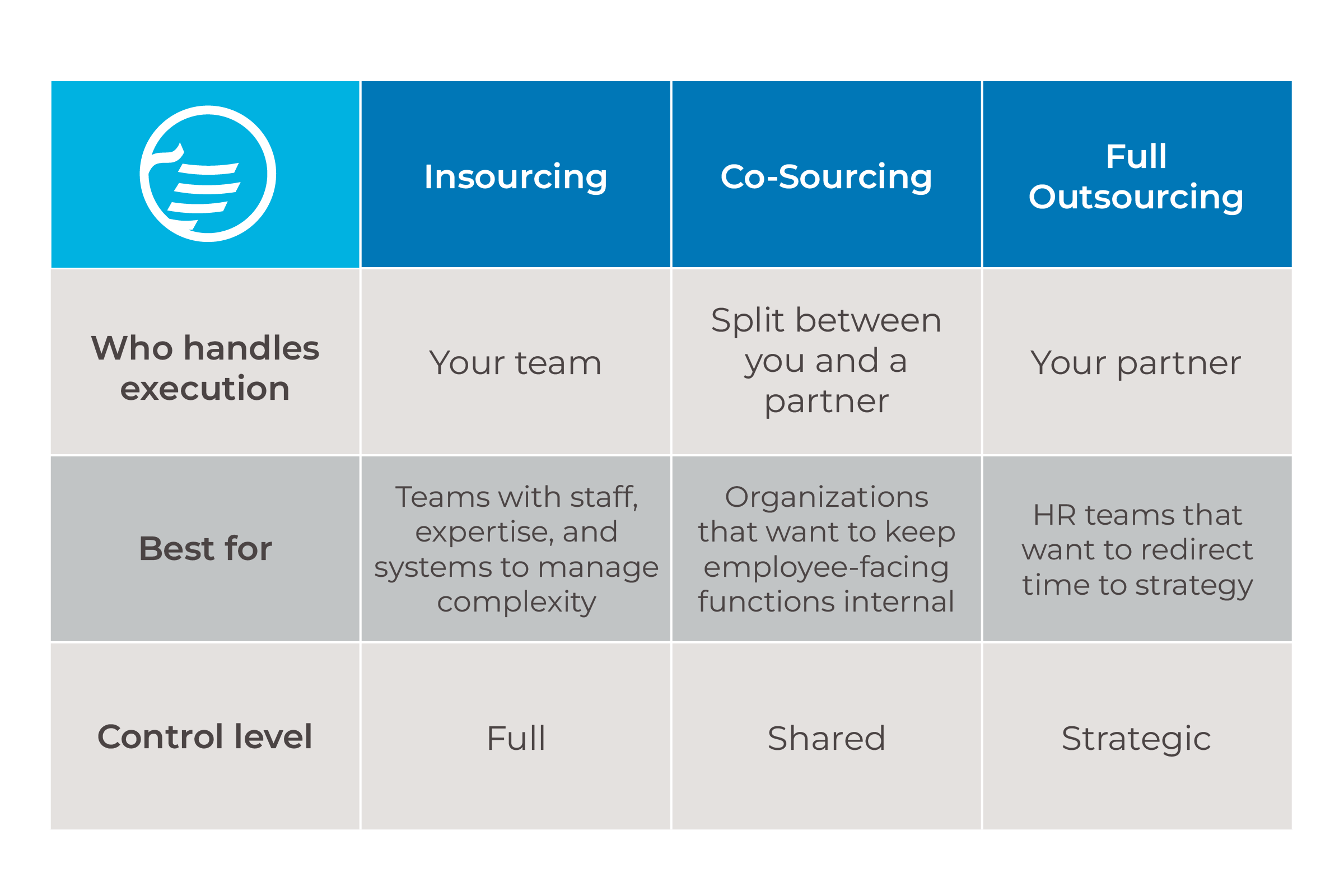
- Full outsourcing transfers most or all benefits administration functions to an external partner. Your team manages the relationship and the strategy; the provider handles execution.
- Co-sourcing is a collaborative split. Certain functions — often employee-facing services like a call center — stay internal, while the more process-heavy work goes to the provider. Organizations that want to maintain direct control over employee interactions, or have reservations about how outsourcing might affect their culture, often start here.
- Insourcing keeps everything in-house, supported by benefits administration technology. This works well when an organization has the staff, expertise, and systems to manage growing complexity, but those conditions are harder to sustain than they look.
Understanding which model fits your organization requires an honest assessment of your team's capacity, your plan complexity, and where your HR function's time is genuinely best spent.
Why More Employers Are Outsourcing Benefits Administration
Research from the International Foundation of Employee Benefit Plans shows that 40% of organizations are outsourcing part of their benefits function. That reflects real structural pressure that has been building for years across compliance, capacity, and employee expectations.
The Compliance Burden Keeps Growing
Managing benefits compliantly has always been demanding. The Affordable Care Act, COBRA, ERISA (Employee Retirement Income Security Act), HIPAA (Health Insurance Portability and Accountability Act) — each carries its own reporting requirements, deadlines, and penalties for getting it wrong.
The regulatory environment doesn't stay still. What was compliant last year may require updated processes this year, and the cost of falling behind is significant: IRS penalties, DOL audits, and employee lawsuits are all on the table.
Most internal HR teams have generalist expertise. Benefits compliance increasingly requires something closer to specialization.
HR Bandwidth Is a Real Constraint
Even well-resourced HR teams have a finite number of hours. When a meaningful portion of those hours goes to administrative tasks — eligibility corrections, carrier discrepancies, and enrollment troubleshooting — something else isn't getting done, whether that's talent strategy, culture work, or manager development.
Outsourcing the administrative layer reorients HR's role in benefits, freeing your HR department to focus on core strategy, program design, and the employee experience that matters most.
Employee Expectations Have Shifted
Employees increasingly expect the same experience from their benefits that they get from consumer technology: self-service access, mobile-friendly interfaces, fast answers, and support available when they need it. That’s not just during open enrollment, either.
A third-party provider whose entire business is built around benefits administration can often be better positioned to deliver that experience consistently than an internal team managing it alongside a dozen other priorities.
When an employee can get a real answer to a coverage question on a Tuesday afternoon in March, that's not a small thing. It can be the difference between a benefits program that drives employee engagement and one that only comes alive once a year.
The Benefits of Outsourcing Benefits Administration and the Honest Trade-offs
Oftentimes, the biggest gains come from what your team gets to stop doing.
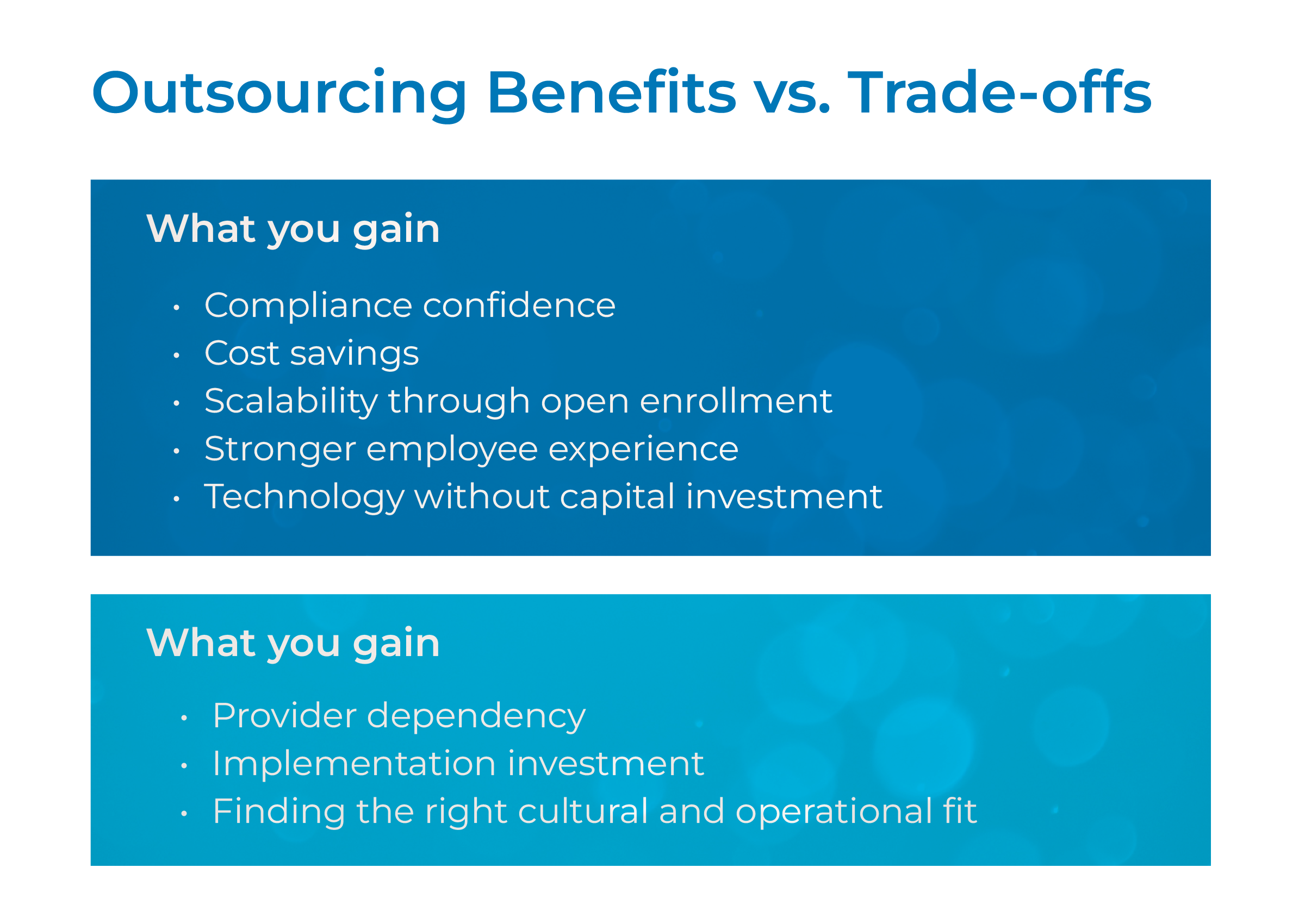
You Stop Stressing as Much About Compliance
Regulatory requirements for benefits programs are not static. ACA reporting, COBRA notices, ERISA disclosure deadlines, HIPAA obligations — each has its own calendar, its own filing requirements, and its own penalty structure for getting it wrong. A dedicated administration partner builds compliance into the process rather than bolting it on at the end. Deadlines get tracked. Changes in regulation get absorbed. Your team stops monitoring federal register updates for fun.
The practical effect is that compliance becomes a background condition rather than a recurring fire drill.
The trade-off: You are now relying on someone else's compliance infrastructure. If their processes have gaps, those gaps belong to you too — your employees, your plans, your legal exposure. The quality of a provider's compliance operation is not something to take on faith during a sales cycle. Ask for specifics. Ask what happened the last time a regulatory deadline changed mid-year.
Less Responsibility for Infrastructure Maintenance
Open enrollment is the obvious pressure point, but the volume problem runs year-round: new hires, qualifying life events, mid-year plan changes, dependent eligibility audits. Internal teams absorb that load until they can't, and then things start slipping. An outsourced model is built for that volume by design — the staffing, the systems, the workflows are sized for it in a way that most internal benefits operations aren't.
You also get access to purpose-built technology without owning it. A platform designed around benefits administration — with carrier connectivity, self-service enrollment, and integrated communications — costs significantly more to build or license independently than it does as part of an outsourcing relationship.
The trade-off: Transitioning to an outsourced model is not a light lift. Data migration, carrier setup, employee communication, change management on the HR side — implementation takes real time and real internal investment before it pays off. Providers who tell you otherwise are underselling it. Ask for a realistic timeline and a clear picture of what your team will be responsible for during the transition.
Capacity to Serve Employees’ Needs Year Round
Most internal benefits operations are built around open enrollment and then stretched thin for the other 10 months. An employee with a coverage question in February or a dependent eligibility issue in July gets whatever capacity the team has left. That's often not much.
A dedicated outsourcing partner exists to support employees throughout the year — not as a side function, but as the primary one. When it works well, employees can get a real answer on a Tuesday in March without it consuming an HR generalist's afternoon.
The trade-off: Not every provider delivers this equally, and the difference usually comes down to service model, not technology. A shared-services arrangement — where your account is one of many handled by a rotating generalist team — tends to produce a different employee experience than a dedicated model where a specific team knows your plans and your population. That distinction rarely surfaces in a demo. Ask directly how your account would be staffed and what continuity looks like after implementation.
What to Look for in a Benefits Administration Partner
If you've decided to explore outsourcing, the next question is how to evaluate providers without ending up with a solution that looks good in a demo and underdelivers in year two.
Choosing the right benefits outsourcing partner — or distinguishing a capable outsourcing company from one that oversells and underdelivers — often comes down to what doesn't appear in a feature matrix.
Service Model Matters as Much as the Technology
Benefits administration technology has become fairly sophisticated across the board. The platform itself is rarely what separates a good outsourced HR experience from a poor one. It’s typically the service model behind it that makes a difference. There are two predominant models in place today.
- A shared-services model means your account is one of many managed by a generalist team. It can work for straightforward programs, but tends to show its limits when plan complexity is high or when employees need support beyond a knowledge base article.
- A dedicated service delivery model assigns a specific team to your account — people who know your plans, your workforce, and your history. The difference in employee experience between these two models is hard to overstate, and it rarely surfaces in a standard RFP response.
Understanding how a provider's service philosophy is structured is one of the most important things you can do before making a decision.
Questions Worth Asking Any Provider
Before committing, get specific answers to the questions that actually predict how the relationship will work day-to-day:
- How do you handle custom eligibility rules and population-level complexity?
- What does implementation look like in practice, including timeline, milestones, and who's responsible for what?
- How do employees reach your team, and what are your response time commitments?
- How does your platform integrate with our existing HRIS and payroll systems?
- How do you stay current on regulatory changes, and what does that process look like for clients?
Building a rigorous benefits RFP is one of the most effective ways to surface the difference between providers who can answer these questions clearly and those who can't.
The Cultural Fit Question
Outsourcing works best when the provider functions as a genuine extension of your HR team rather than a transactional outsourcing firm processing work at arm's length. That requires cultural alignment, and it's worth evaluating explicitly rather than assuming it will work itself out.
The best providers build cultural immersion into implementation: learning your workforce, your communication norms, your organization's values. That investment shows up later when employees interact with the service center and feel like they're talking to someone who understands their company, not just their plan documents.
Outsourcing doesn't mean ceding control of the employee experience. With the right partner, it can actually strengthen it. No provider evaluation is complete until you've stress-tested the service model, gotten honest answers to the hard operational questions, and assessed whether the cultural fit is real or just well-rehearsed in a sales cycle.
Making the Decision That's Right for Your Organization
A well-structured outsourcing arrangement can significantly reduce the operational drag on your HR function and clarify what you believe HR is for. The decision is unique to each organization, though.
Outsourcing Isn't the Right Answer for Everyone
If your team's best work is building a benefits program that reflects your culture, supports your people through meaningful moments, and gives your organization a real edge in talent, then the real question is how to handle administration.
That case for outsourcing is compelling in that case, but it isn't universal.
Some HR teams have the staff and systems to manage complexity well in-house. Some have plan structures genuinely better served by internal administration. Some organizations simply aren't ready for the implementation investment a good outsourcing transition requires. What matters is being honest about which situation you're actually in, not which one is easier to defend to leadership.
Trust Is Part of the Decision
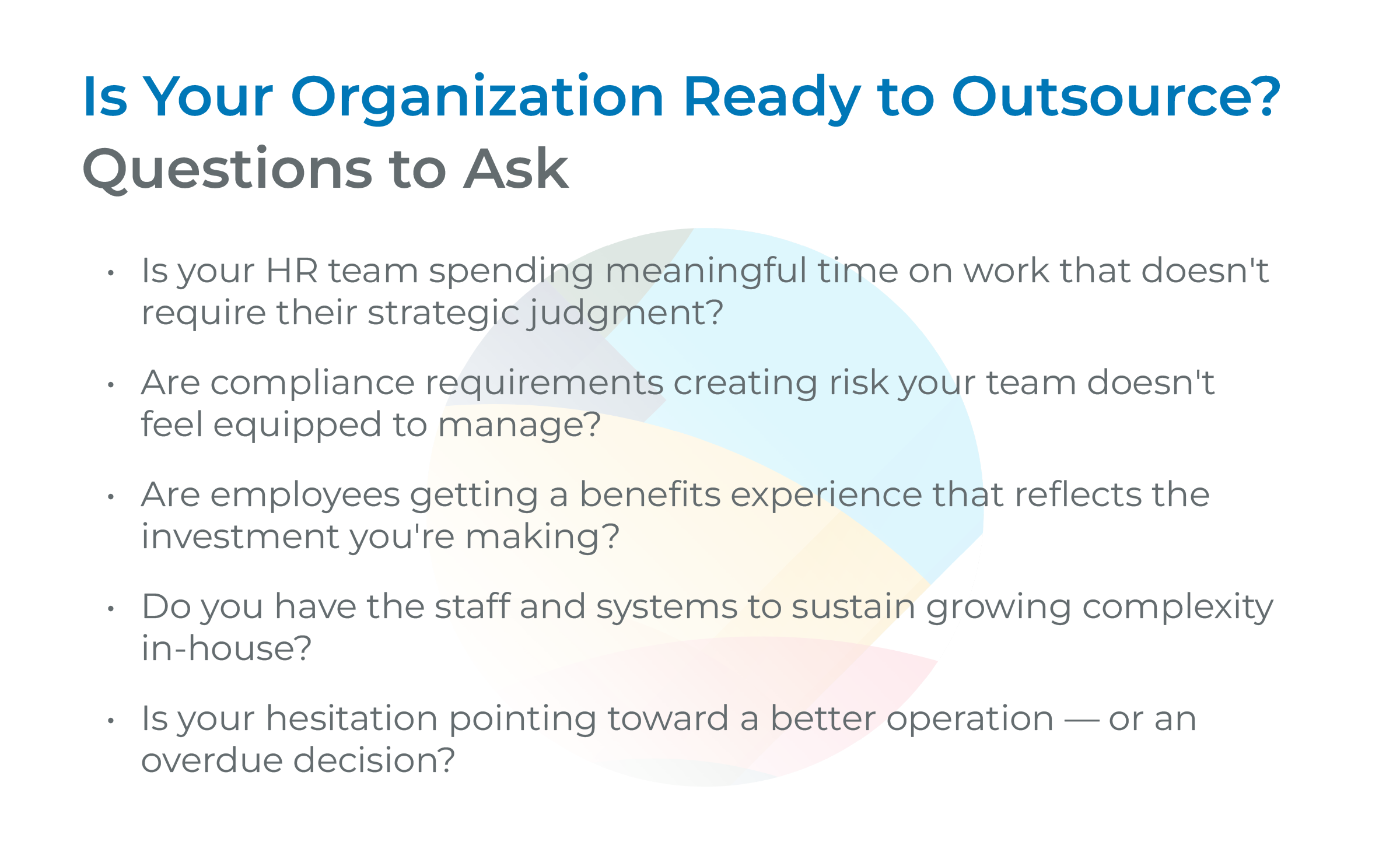
The hesitation most HR leaders carry into this decision is worth naming directly: You're being asked to trust a third party with something that affects every single employee's life.
Health coverage and dependent eligibility. Benefits plans that have to be administered accurately and COBRA notices that have to go out on time. Getting any of that wrong has real consequences for real people. It's reasonable to be cautious about who you extend that responsibility to.
That caution is appropriate. The question is whether it's leading you toward a better in-house operation or toward avoiding a decision that's already overdue. Understanding and ultimately trusting a potential partner is key to overcoming this hesitation.
Reframe What "Control" Actually Means
The framing of "handing it off" is part of what makes this feel riskier than it often is. The right outsourcing relationship doesn't remove your team from the equation. It simply changes where your energy goes.
You remain accountable for the program. You remain the relationship owner with your employees. What you gain is a partner specifically built to execute the work that's currently consuming your team's capacity, with the infrastructure and expertise to do it better than most internal operations can sustain.
That's not a loss of control. It's a choice about where your control is best directed.
If you're ready to explore what that looks like in practice, Empyrean works with organizations across industries and plan complexity levels to build benefits administration programs that serve employees year-round — not just during open enrollment. A conversation is a reasonable next step.