
For an employer with 1,000+ workers on family coverage, benefits billing errors can add up to a potential exposure of half a million dollars a year. Most of it is buried in stale eligibility records, EDI feed errors, and dependents who should have been removed months ago.
It's a financial and compliance exposure most organizations never stop to measure. If you haven't audited yours lately, there's a good chance you're paying for it.
The failure points are predictable. So are the fixes.
What Is Benefits Data Management?
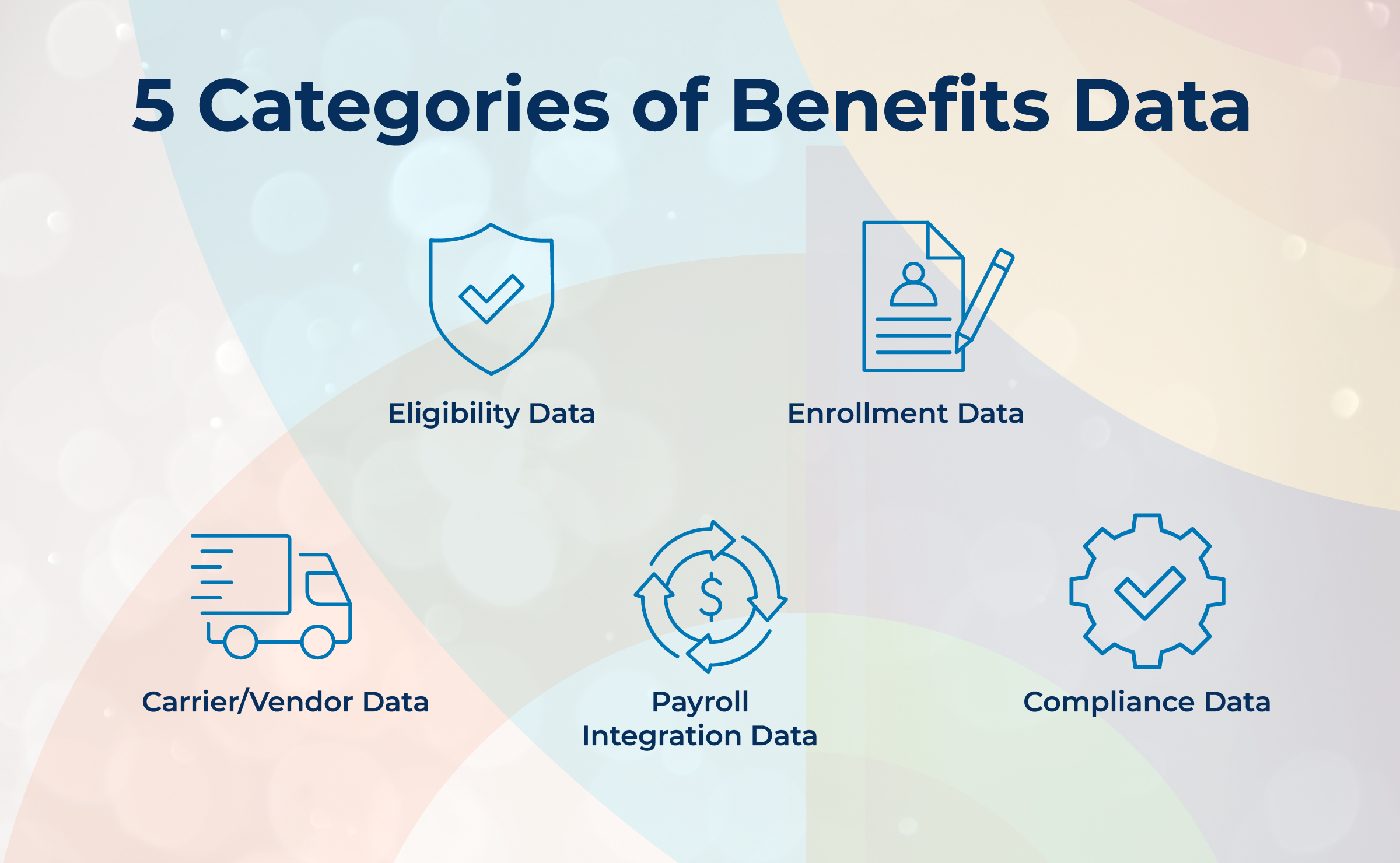
Benefits data management includes the collection, validation, storage, maintenance, and transmission of the employee data that governs benefit eligibility, enrollment, coverage, and compliance. Any benefits management system worth evaluating must handle all five core data categories in play at any given moment:
- Eligibility data: employment status, hire date, termination date, hours worked, pay frequency, location
- Enrollment data: benefit elections across medical, dental, vision, life, disability, FSA (Flexible Spending Account), HSA (Health Savings Account), and voluntary plans
- Carrier/vendor data: EDI 834 files, the standard transaction format for transmitting enrollment and coverage data to insurance carriers
- Payroll integration data: premium deductions, employer contributions, HSA/FSA funding amounts
- Compliance data: ACA (Affordable Care Act) reporting, COBRA (Consolidated Omnibus Budget Reconciliation Act) qualifying events, ERISA (Employee Retirement Income Security Act) plan documentation, HIPAA (Health Insurance Portability and Accountability Act) data handling
The average organization manages all of this across 11 different HR systems, pulling from multiple data sources without a single authoritative record. That's 11 opportunities for records to diverge, for updates to lag, and for errors to compound before anyone notices.
The Real Cost of Benefits Data Errors
Most HR teams know data accuracy matters. Fewer have a clear picture of what inaccuracy from poor data management practices can cost them until a carrier invoice or compliance notice forces the issue.
The Financial Exposure
Industry estimates put benefits billing errors at 1–2% of total premium spend. With average family coverage premiums reaching $26,993 in 2025, that translates to a potential exposure of $270,000 to $540,000 annually for an employer with 1,000 covered workers. Most of it goes undetected until a formal reconciliation forces the issue.
Dependent eligibility is a major driver. Periodic audits typically find that 5–7% of enrolled dependents are ineligible. Those enrollees are generating premiums and, in some cases, claims, for coverage they shouldn't have. That's a direct drag on benefits utilization and plan cost.
The Compliance Exposure
The regulatory exposure amplifies the financial one. Current ACA (Affordable Care Act) penalties run $2,900 per eligible employee annually for Part A violations and $4,350 per employee for Part B. ACA Information Return filing errors carry an additional $340 per return. HIPAA violations range from $127 to $63,973 per incident, and ERISA Section 209 adds $10 per employee for each recordkeeping failure, with records required for six years from the date of filing.
The best way to ensure that data errors don't compound is to catch them through regular reviews.
The Most Common Benefits Data Problems
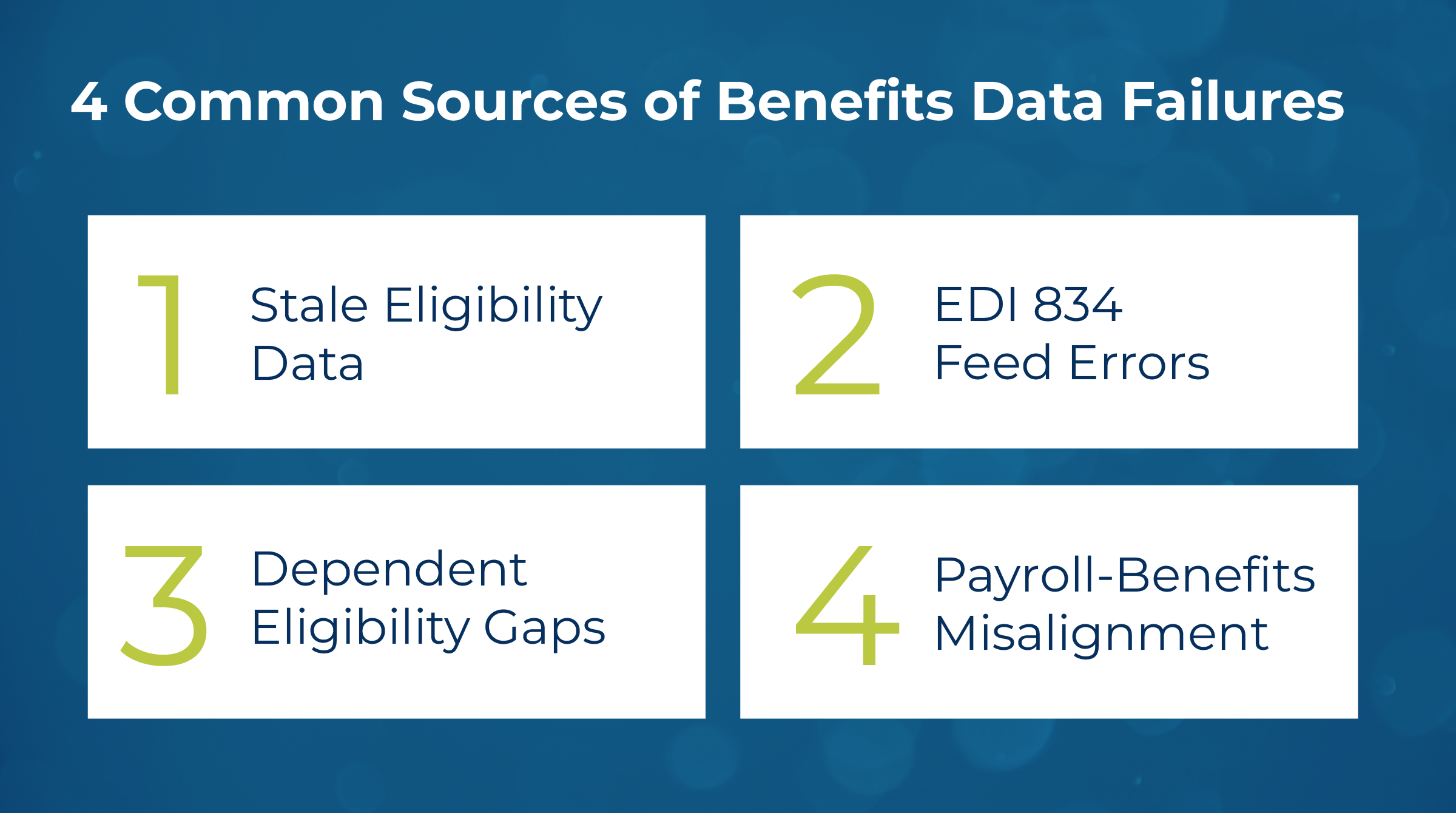
Data errors rarely happen all at once. They accumulate: one missed update, one feed failure, one system that never got the memo. Here are the failure points that show up most often.
Stale Eligibility Data
The most common and costly data integrity failure. An employee terminates, but the benefits platform isn't updated promptly, and premiums keep flowing for someone who's no longer employed.
Terminations are the obvious case, but life event changes create the same problem: a dependent ages off a plan, a spouse gains coverage elsewhere. Ensuring data stays current is as much a timing problem as a technology one, and every delayed update is a billing error waiting to surface.
EDI 834 Feed Errors
Electronic Data Interchange 834 files are the backbone of carrier data exchange — the standard format governing data sharing between benefits platforms and insurance carriers. Common failure points include incorrect plan codes, missing member IDs, and timing mismatches between when a change is made in the benefits platform and when it reaches the carrier.
EDI errors are often invisible until a carrier reconciliation or a claims denial surfaces them. By then, the discrepancy may have been accumulating for months.
Dependent Eligibility Gaps
The 5–7% ineligible dependent rate is the natural result of enrollment processes that make it easy to add dependents and hard to remove them. Without periodic dependent verification programs, ineligible enrollees stay on plans indefinitely.
Payroll-Benefits Misalignment
When payroll and benefits systems don't sync cleanly, deductions and contributions drift. The average payroll accuracy rate is 80%, meaning roughly 1 in 5 paychecks contains an error. For employees, that means incorrect deductions. For HR, it means fielding complaints that are difficult to trace without a full audit trail across both systems.
6 Best Practices for Stronger Benefits Data Integrity
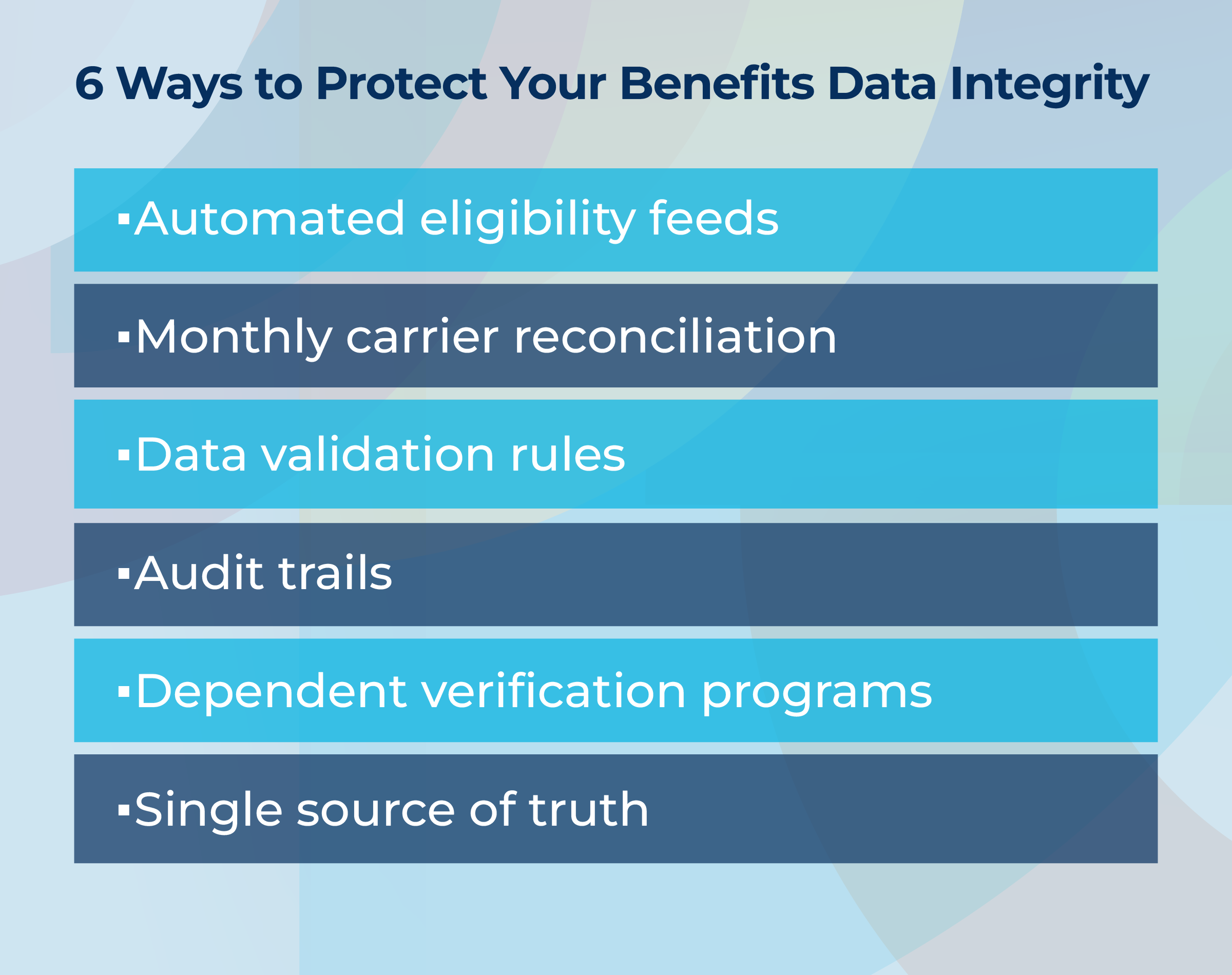
Good benefits data management is an ongoing operational discipline, not a one-time cleanup. These six practices define what that looks like.
- Automated eligibility feeds: real-time HRIS-to-benefits platform integration so that terminations, life events, and classification changes flow through without manual intervention, which reduces the risk of ghost enrollments and missed terminations
- Monthly carrier reconciliation: not quarterly, not annually; discrepancies grow the longer they go undetected
- Data validation rules: enforce required fields, format checks, and cross-system consistency, catching data entry errors at the point of origin rather than downstream
- Audit trails: every change logged with timestamp and user ID, creating a defensible record for compliance purposes
- Dependent verification programs: periodic audits to identify and remove ineligible dependents before they become billing or claims issues
- Single source of truth: designate one system as authoritative for each data type so that downstream systems follow, not compete
The gap between organizations that manage data well and those that struggle usually comes down to whether their technology supports operational efficiency or forces workarounds.
What to Look for in a Benefits Platform's Data Management Tools
A sound data management strategy starts with knowing what your platform can actually do. A dedicated benefits administration platform and an HCM's add-on benefits module handle data very differently, and that gap tends to show up here first. When evaluating your current system, these are the capabilities worth pressure-testing:
- Automated EDI 834 generation and transmission with error alerting, so feed failures surface immediately rather than silently
- Real-time eligibility APIs: batch processing introduces lag; real-time integration eliminates it
- Carrier reconciliation dashboards that compare billing vs. enrollment records side by side
- Built-in ACA (1094-C/1095-C) and COBRA compliance reporting, native to the platform rather than bolted on
- HIPAA-compliant data architecture with full audit logging and access control, where data security is built into the platform rather than added on top — part of what separates platforms with enhanced benefits capabilities from basic HCM modules
A purpose-built benefits administration platform treats reliable data as a core product requirement. HCM platforms often treat benefits as one module among many, which means data management features tend to be less mature and harder to maintain at scale.
Choosing between the two is a strategic decision with long-term data consequences. The telling question for any platform: does it make reconciliation easy, or does it make reconciliation necessary because the data is already fragmented?
HR Data Integrity Starts With the Right Foundation
Managing data across a benefits program has no finish line. The data is always moving: new hires, terminations, life events, open enrollment, carrier file transmissions, payroll cycles. Every one of those events is an opportunity for a record to drift out of sync.
The organizations that handle it well have built real-time integrations, automated validation, and regular reconciliation into their operations — and a connected benefits experience that keeps HR out of the business of manually bridging system gaps.
If you want to see how that works in practice, request a demo of Empyrean's benefits administration platform.