
The standard model of benefits communication starts from an assumption: employees are passive, and communication is how you activate them. More emails before open enrollment. A better campaign. A louder message.
That assumption shapes everything. And it's usually wrong.
The Empyrean Research Institute's Employee Benefits in 2026 report tells a different story. Employees are already making deliberate choices. Supplemental disability, hospital indemnity, critical illness, and accident coverage all grew last year, paid for out of pocket, and layered on top of base plans. That's active financial planning, not passive enrollment. The question is whether your communication strategy gives them what they need to make good decisions.
Closing that gap is what effective benefits communication is designed to do. Here's how to build one.
Why Traditional Employee Benefits Communication Strategies Fail
The activation model misdiagnoses the problem. When enrollment is low or utilization lags, the instinct is to build a more aggressive benefit communication plan: more touchpoints, more channels, a louder open enrollment campaign. But more of the wrong thing doesn't address the underlying structure. And the underlying structure is usually the problem.
The Utilization Gap is Real and Costly
MetLife's research finds that 62% of employees say they're not completely confident about all the perks and benefits available to them, meaning many employees don't fully understand their benefits offerings even after enrolling.
The same research notes that misunderstanding and underutilization of benefits persists across organizations of every size, and that the cost falls on both sides: Employees who miss out on support they're entitled to, and employers who fund programs that go unused.
This is an evergreen problem. Employees who don't use their benefits don't get the health, financial, and mental health support those benefits are designed to provide. That affects productivity, absenteeism, and retention in ways that compound over time.
HR's Timeline Doesn't Match the Employee's Life
Most benefits programs are organized around a single communication peak: ramp up before open enrollment, go relatively quiet after. That calendar makes sense for HR operations. It has almost nothing to do with when employees actually need benefits information.
Across a diverse workforce, employees are navigating life events in every month of the year: marriage, a new child, a health diagnosis, retirement plans coming into focus. When those moments arrive, what they have is whatever they remember from a campaign months ago. Effective benefits communication has to meet employees where they are, not where HR's administrative calendar lands.
Bulk Information Arrives at the Wrong Moment
Even well-designed content fails when it arrives at the wrong moment. A campaign email about how an HSA works lands differently in August, when employees are skimming a crowded inbox, than it would at the moment they're actually selecting a health plan and deciding whether to pair it with a savings account.
Broadcast communication asks employees to retain and apply information out of context. Delivered in bulk weeks before the decision it's meant to support, it rarely lands. The problem isn't the content. It's the architecture that separates communication from the moment of need.
How to Build an Effective Employee Benefits Communication Strategy
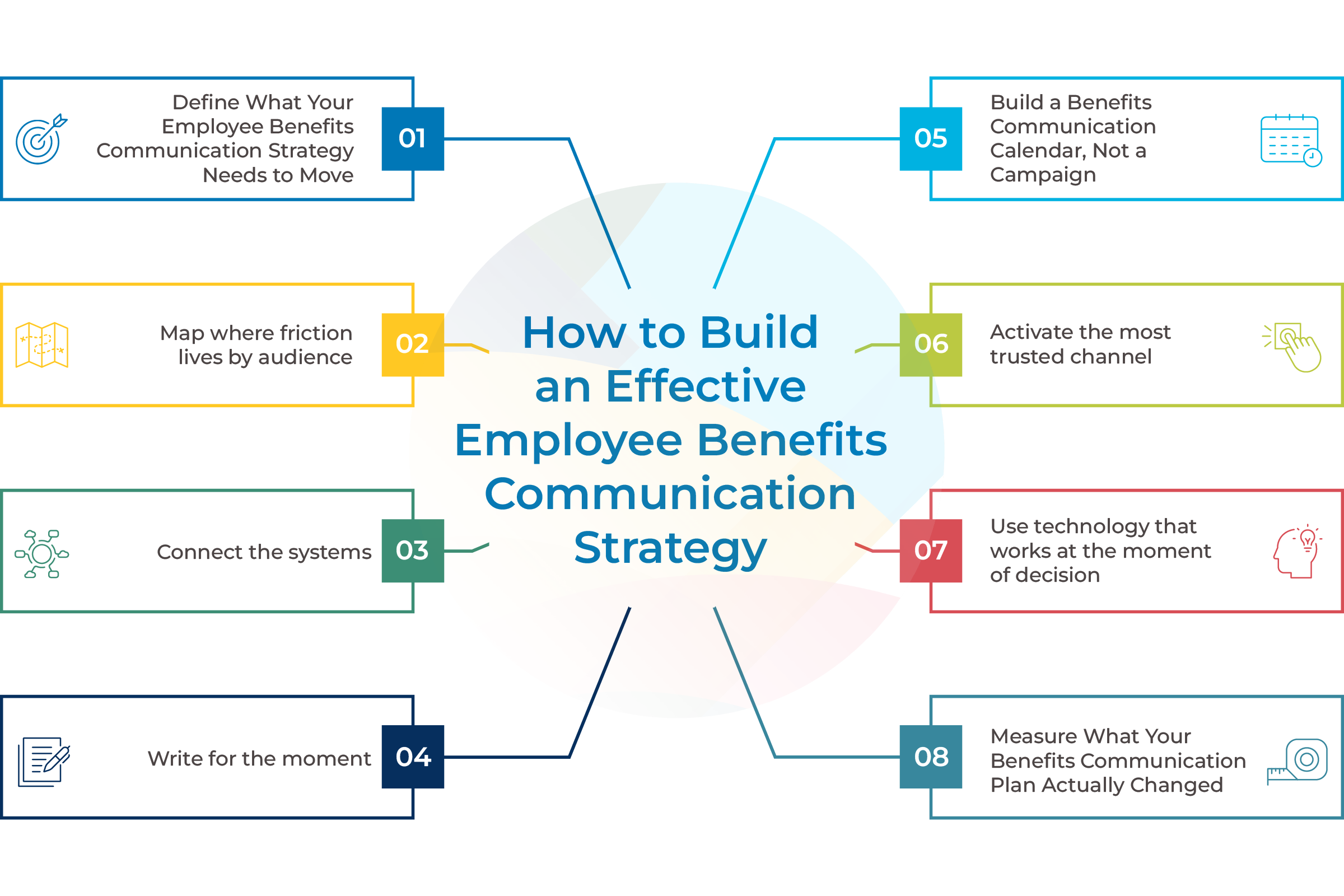
A benefits communication strategy isn't a content calendar. It's a set of decisions about where friction lives and how to eliminate it at each point in the employee's experience of their benefits program.
Define What Your Employee Benefits Communication Strategy Needs to Move
Strategy without goals is just activity. Before building anything, define what success looks like in measurable terms: enrollment rates by benefit type, utilization targets, employee satisfaction scores, HR inquiry volume. These aren't just reporting metrics. They're the benchmarks that tell you whether communication is actually changing behavior, and where to focus when it isn't. Ensure that employees moving from confusion to confidence shows up in the numbers you track.
Map Where Friction Lives by Audience
A single benefits communication strategy can't serve every employee equally. A new hire doesn't need the same thing as an employee approaching retirement. A frontline worker on a manufacturing floor experiences friction differently than a remote knowledge worker. Across a diverse workforce that spans multiple generations, life stages, and work environments, employees feel the friction in different places, and a strategy that doesn't account for that will keep missing them.
Map employee personas by factors like life stage, job type, and benefit eligibility. Find where employees don't engage with specific benefits offerings and ask what's blocking them before assuming they don't care.
Connect the Systems
Communication channels are often treated as a menu of options (email, mobile app, video, social media, face to face) rather than as infrastructure that connects to the system where benefits decisions actually happen. When the ben-admin platform and the communications infrastructure are integrated, education can happen at the moment of decision: an employee reviewing a high-deductible health plan (HDHP) sees guidance on how an HSA works right alongside their enrollment options, not in a separate email from weeks ago.
That's point-in-time education, and it's structurally different from a campaign. When the platforms are siloed, that moment is lost regardless of channel mix or content quality.
Write for the Moment
Benefits packages are genuinely complex, and employees who encounter jargon or dense plan comparisons tend to disengage fast. Plain language and WIIFM (“what's in it for me”) framing make the difference between benefit information that gets used and benefit information that gets ignored. Bite-sized content works better than comprehensive guides for most moments: a short explainer on how an Flexible Spending Account (FSA) works at the point of enrollment does more than a 20-page guide delivered in August.
Writing for the moment also means writing for the person, not the compliance requirement. Employees feel the difference between a message designed to inform them and one designed to protect HR.
Build a Benefits Communication Calendar, Not a Campaign
The goal isn't more communication. It's communication that arrives when employees need it. A year-round benefits communication calendar built around employee need moments, rather than HR deadlines, is what makes that possible. The calendar section below maps out what that looks like in practice across all four quarters of the year.
Activate the Most Trusted Channel
Managers are among the most trusted sources of information in an employee's work life and one of the most underused channels in any benefits communication strategy. Employees who hear about a mental health benefit directly from their manager are far more likely to use it than those who received an email about it in September. A face-to-face conversation carries weight that broadcast communication can't replicate.
Equipping managers with talking points, short FAQs, and clear language for one-on-ones extends the reach of the communications strategy without adding to HR's workload, and puts benefit information in the hands of someone employees trust.
Use Technology That Works at the Moment of Decision
Self-service portals, mobile apps, and AI-powered guidance tools change the calculus on benefits communication by making information accessible when employees need it rather than when HR sends it. For frontline and dispersed workforces, mobile-first delivery isn't a nice-to-have; it's the only communication channel that reliably reaches employees who are rarely at a desk.
Technology also enables personalization at scale: an employee who enrolled in an HDHP but hasn't engaged with their HSA gets a nudge about making the most of their account, not a general benefits overview they've already seen.
Measure What Your Benefits Communication Plan Actually Changed
Close the loop. A benefits communication plan that doesn't get measured doesn't get better. The KPIs section below covers what to track and why.
Start by Developing a Year-Round Benefits Communication Calendar
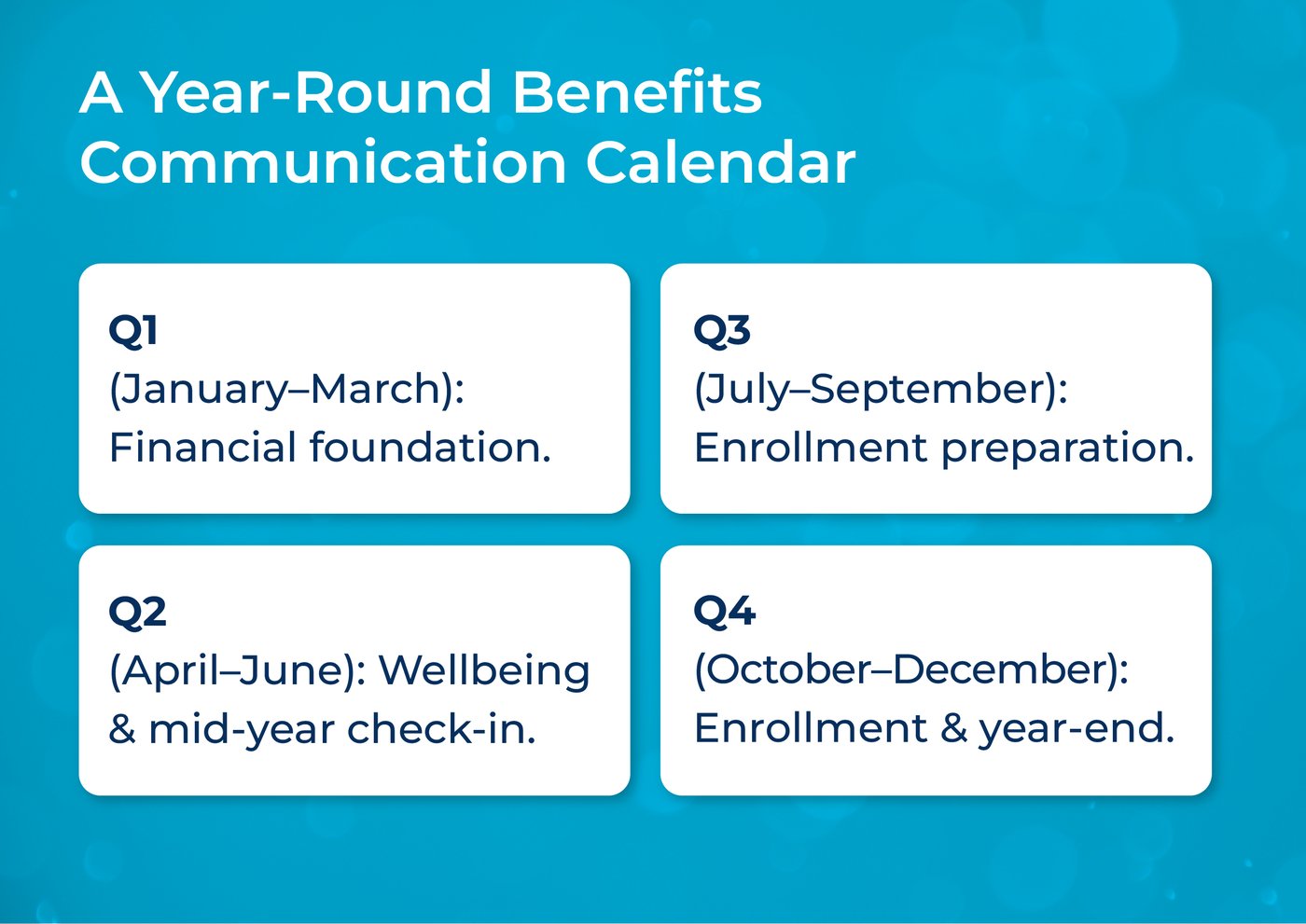
Most ben-admin teams have a busy October. The rest of the year, benefits go relatively quiet until an employee needs something and has nowhere to turn.
A year-round benefits communication calendar is the strategy made visible. When every activity has a purpose tied to an employee need moment, communication stops being reactive.
-
Q1 (January–March): Financial foundation. The new year is when employees are most likely to be thinking about money: what they spent, what they want to do differently. FSA and HSA balance reminders, benefits orientation for employees who just completed open enrollment, financial wellness resources, and tax season tie-ins all land with relevance because they meet employees where they already are mentally. This is also the right moment for retirement plans education, when employees are thinking about the year ahead.
-
Q2 (April–June): Wellbeing and mid-year check-in. Mental health awareness in May, spring wellness campaigns, and a mid-year retirement savings check for employees who set contribution goals in January and haven't revisited them. Proactive Q2 communication reaches employees before a need becomes urgent, rather than after they've already made a costly decision without the right benefit information.
-
Q3 (July–September): Enrollment preparation. The open enrollment window should open to an informed workforce. Q3 builds that foundation: "what's changing this year" education, bite-sized decision support content that helps employees think through their options before the window opens, and manager enablement kits so frontline leaders are ready for face to face questions. For a deeper playbook on running the enrollment campaign itself, [the open enrollment guide for HR teams] covers the full execution.
-
Q4 (October–December): Enrollment and year-end. The campaign runs, but so does year-end: FSA deadline reminders in November, holiday stress and Employee Assistance Program (EAP) awareness in December, close-of-year retirement account checkpoints, etc. When enrollment communication is well-designed and delivered through connected channels, it moves outcomes. That's not theoretical; it's measurable.
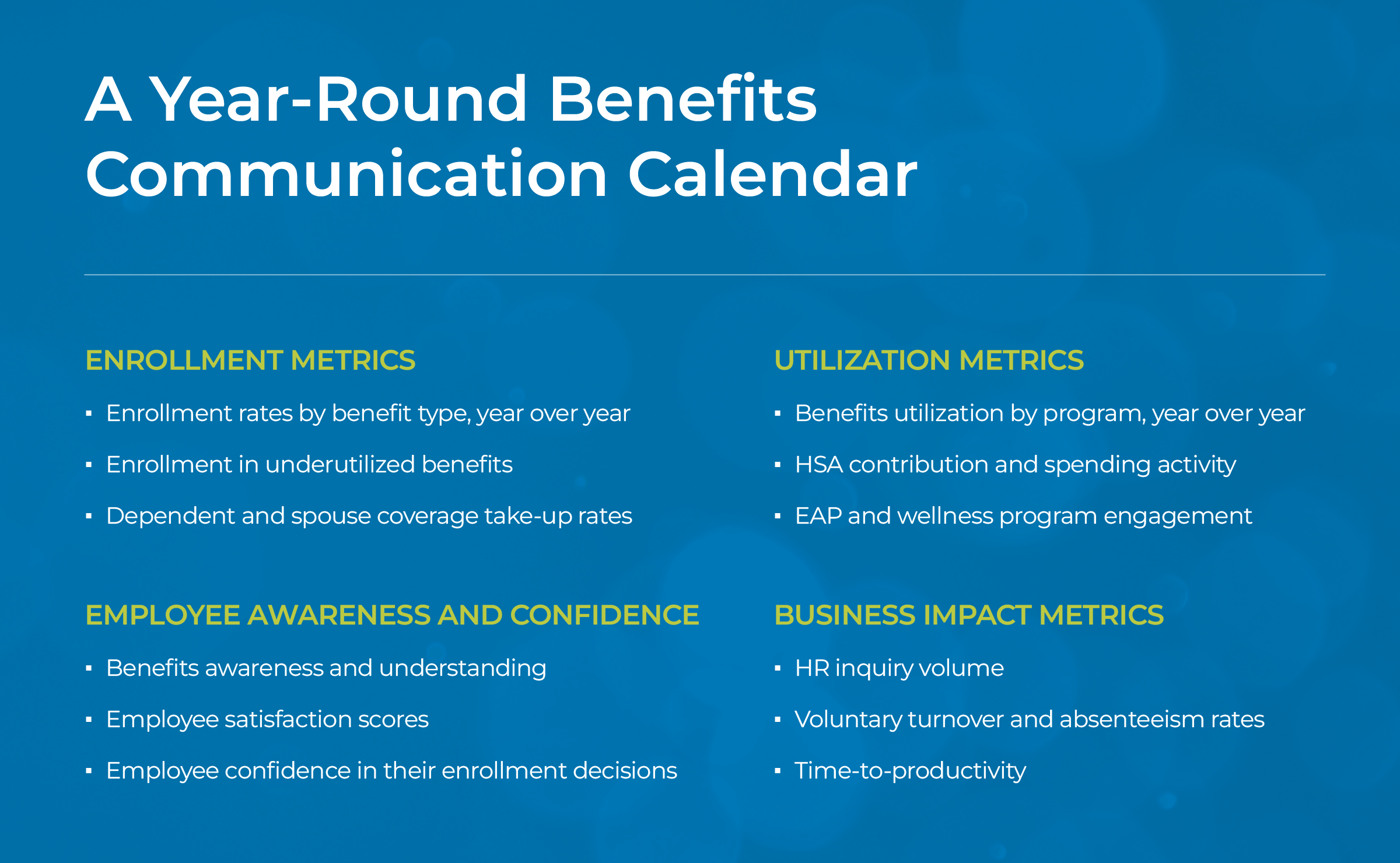
KPIs for Your Employee Benefits Communication Strategy
The most common mistake in measuring a benefits communication strategy is tracking what was sent rather than what changed. Open rates and click-through rates tell you whether communication is landing, but they're a starting point, not an endpoint. The KPIs that matter are the ones that show whether friction is actually coming down.
Enrollment metrics
- Enrollment rates by benefit type, year over year
- Enrollment in underutilized benefits (supplemental coverage, voluntary benefits, HSA)
- Dependent and spouse coverage take-up rates
Utilization metrics
- Benefits utilization by program, year over year
- HSA contribution and spending activity
- EAP and wellness program engagement
Employee awareness and confidence
- Survey responses on benefits awareness and understanding
- Employee satisfaction scores tied to benefits experience
- Employees feel confident in their enrollment decisions (pulse survey data)
Business impact metrics
- HR inquiry volume (one of the clearest signals that friction is coming down)
- Voluntary turnover and absenteeism rates
- Time-to-productivity for new hires who complete benefits enrollment
Benchmark against goals, not activity. Sending more emails isn't progress. Cutting the calls that flood HR every fall is.
Designing an Employee Benefits Communication Strategy Around the Employee
Empyrean's platform connects benefits administration and employee communications in a single branded experience year round on their terms. Information reaches employees at the moment of decision, not weeks before in an email they may not have opened.
The platform delivers mobile-first reach for frontline and dispersed workforces, and conversational AI handles 24/7 benefits guidance at scale no human-only HR team can. Plus, Empyrean’s Experience Lab provides communication strategy and custom content support for employers who want custom campaigns that drive real outcomes.