
Personalizing employee benefits means giving people coverage and guidance that reflects where they actually are: their family situation, their financial concerns, the healthcare decisions they’re facing right now.
AI is increasingly part of how benefits platforms are delivering that personalization by analyzing enrollment patterns, surfacing relevant voluntary coverage, and guiding employees to better decisions at the right moment. The same capability raises real privacy concerns: according to McKinsey, 43% of US employees cite personal privacy as a top concern with AI in the workplace, a number that rises sharply when it’s connected to health and benefits data.
For HR and benefits leaders, the challenge is delivering both: personalization that helps and a privacy approach employees can trust.
Why Personalizing Employee Benefits Has to Include Privacy
Employees have come to expect benefits that fit their situation, not just their job category. The pressure on benefits leaders to personalize isn’t new. What’s changed is the technology making it possible at scale, and the scrutiny that technology now attracts.
When personalization outpaces trust, the cost is real. According to MetLife’s 2025 Employee Benefit Trends Study, 81% of employees hold their employer accountable for building trust at work. When that trust breaks down, benefits engagement is one of the first casualties. Employees disengage from voluntary programs, stop using personalized tools, and raise their concerns publicly.
The compliance exposure compounds the problem. HIPAA, the CCPA (California Consumer Privacy Act), ERISA (Employee Retirement Income Security Act), and FTC enforcement all govern how employee benefits data can be collected and used, and enforcement in each of these areas is expanding. Cisco research found that 37% of consumers have terminated relationships with companies over data concerns. In a benefits context, that translates to employees who quietly opt out of every program you’ve built.
Personalizing employee benefits without a clear privacy framework doesn’t just create legal risk. It undermines the employee trust that makes personalization worth doing in the first place.
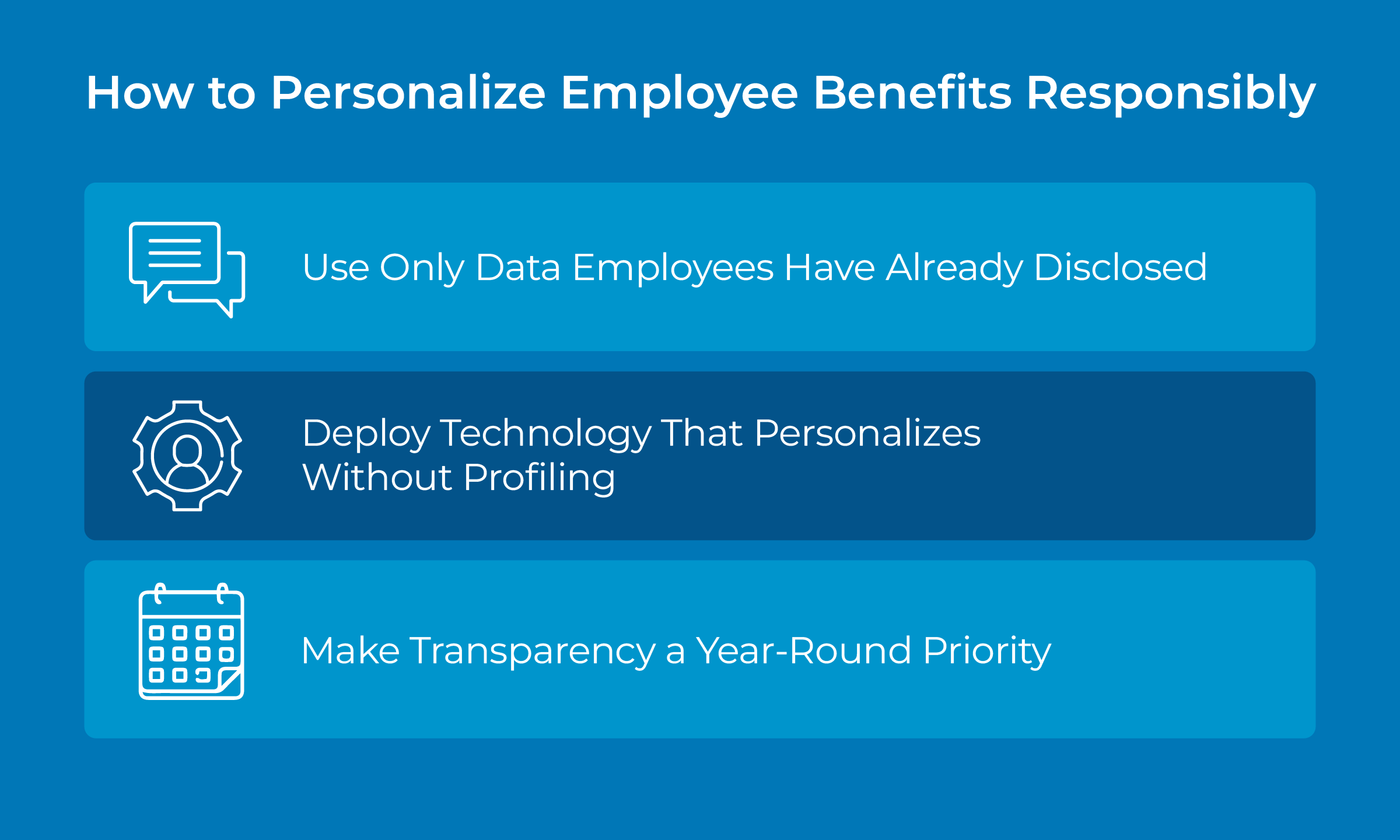
How to Personalize Employee Benefits Responsibly
The goal isn’t surveillance. It’s relevance. HR leaders who get this right build personalization programs around what employees have already shared, use technology designed to minimize data exposure, and treat transparency as an ongoing responsibility rather than a disclosure checkbox.
Use Only Data Employees Have Already Disclosed
The line between helpful and intrusive comes down to consent. Effective personalization works from behavioral signals, enrollment patterns, and life events employees have already shared. Three approaches demonstrate what this looks like in practice:
- Claims-triggered alerts. When an employee files a hospital claim, the platform surfaces information about hospital indemnity benefits they may already be eligible for. Most employees would never find this on their own. Delivering it at the right moment turns existing coverage into coverage they can actually use.
- Life-stage targeting. A parent navigating summertime childcare costs is a different audience than a new hire selecting benefits for the first time. Platforms that surface dependent care FSA (Flexible Spending Account) reminders or backup childcare benefits during peak months turn generic programs into genuinely useful tools.
- Financial profile guidance. Personalized prompts encouraging HSA (Health Savings Account) contributions early in a career, before medical costs accumulate, or catch-up contributions for employees approaching 55 can meaningfully improve long-term financial outcomes.
None of these require employees to surrender sensitive health data. They work from what employees have already disclosed through normal enrollment activity.
Deploy Technology That Personalizes Without Profiling
The strongest AI-powered benefits tools are specifically designed to reduce individual data exposure while still delivering relevant guidance. Three approaches work particularly well:
- Session-limited virtual assistants that guide employees through plan comparisons, flag enrollment deadlines, and explain coverage terms without storing sensitive health data beyond the session
- Cohort-based recommendation engines that surface benefit suggestions based on anonymized patterns within similar demographic groups, rather than individual employee profiles
- Predictive analytics that identify gaps in engagement or utilization at the program level, without linking findings back to individual identities
These approaches deliver personalization that feels relevant without requiring employees to trade their privacy for it.
Make Transparency a Year-Round Priority
Employees who don’t understand how their data is being used will disengage from benefits programs, especially voluntary ones that require active enrollment. Transparency isn’t an open enrollment task. It’s a year-round communication responsibility.
Leading employers address this by making privacy education a consistent thread across the entire benefits experience:
- Explaining AI tools in plain language during onboarding and annual enrollment, not just in legal disclosures
- Defining what data is collected, why it’s used, and who has access
- Reinforcing that participation in personalized features is always optional
- Weaving privacy messaging into email, the benefits portal, and manager toolkits
Employees who feel informed are more likely to trust and use what’s available to them. That trust is what makes benefits engagement possible at scale.
What to Look for in a Benefits Technology Partner
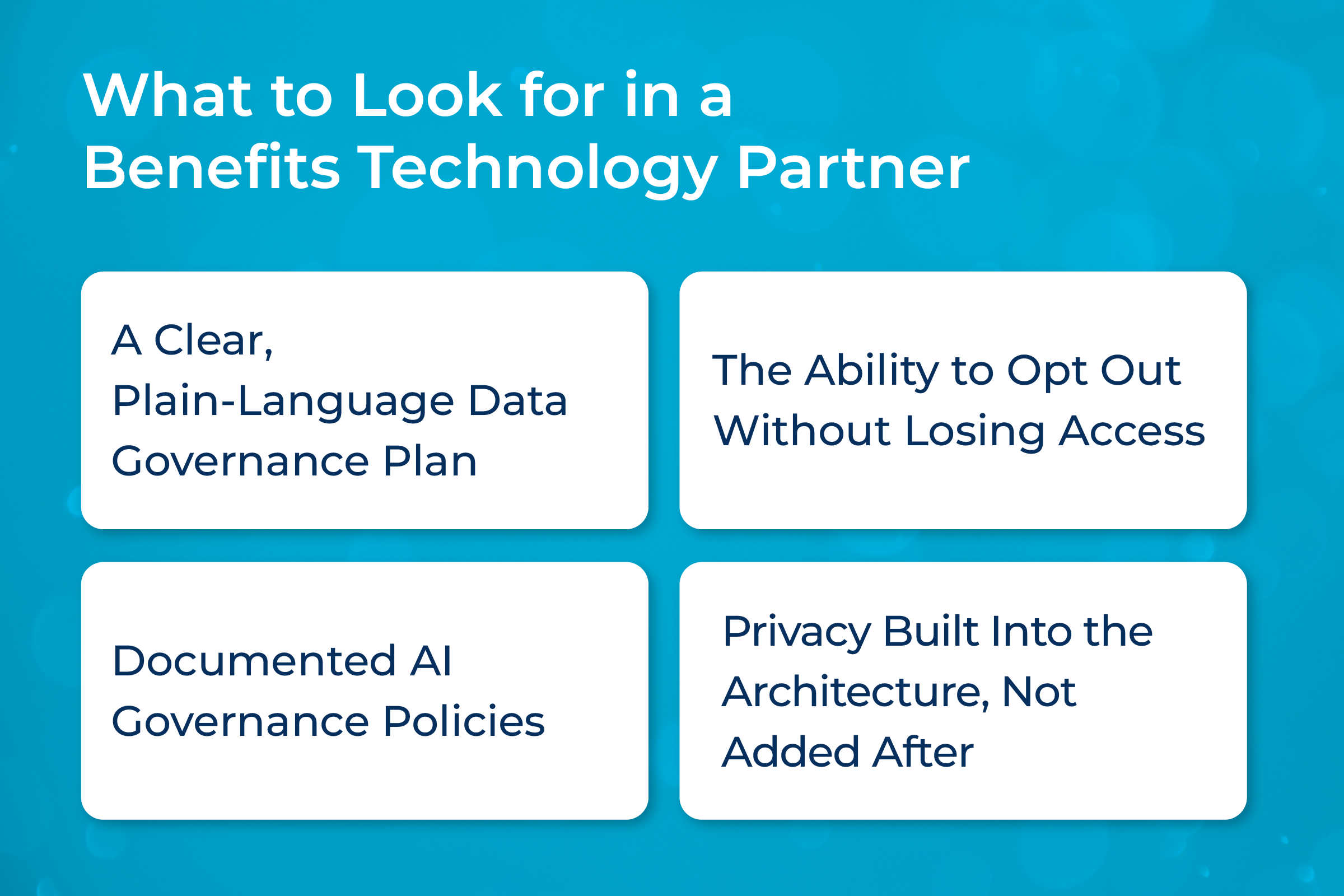
Delivering privacy-protected personalization depends as much on the platform you choose as on the policies you set. The right partner has privacy built into how their technology works, not layered on as an afterthought. Four criteria help separate platforms worth trusting from those that aren’t.
A Clear, Plain-Language Data Governance Plan
A trustworthy partner can articulate precisely what employee data is collected, how long it’s retained, who has access, and under what circumstances it gets shared. That documentation shouldn’t require a legal review to understand. If a vendor can’t answer these questions clearly, that’s meaningful information about how seriously they take employee data.
The Ability to Opt Out Without Losing Access
Personalization should always be opt-in. Employees should have full access to benefits enrollment and information whether or not they participate in data-driven features. A platform that makes personalization a condition of access puts data collection ahead of employee trust.
Documented AI Governance Policies
As AI becomes more deeply embedded in benefits administration, the company behind the platform should be able to explain specifically how AI output is validated, what guardrails exist around health-related decisions, and how errors are handled. Vendors who can’t answer these questions clearly shouldn’t be trusted with employee health data. Capabilities matter. Governance matters more.
Privacy Built Into the Architecture, Not Added After
There’s a meaningful difference between a platform that built privacy protections into its architecture from the start and one that layered policies on top afterward. Ask specifically how the platform limits individual data exposure through cohort modeling, anonymization, or session-limited storage. The answer reveals whether privacy was a design principle or a compliance checkbox.
Organizations that get this right choose partners whose privacy architecture is as intentional as their personalization capabilities. They treat transparency with employees not as a one-time disclosure but as an ongoing commitment that shapes how the entire benefits experience is built.
Getting Personalization Right
Personalizing employee benefits has moved from differentiator to baseline expectation. What separates organizations that do it well is transparent communication, consent-first design, and a technology partner with genuine accountability built into how they operate.
To see how Empyrean approaches the balance between personalization and privacy, request a demo.
Frequently Asked Questions About Personalizing Employee Benefits
Personalized benefits use data employees have shared — including enrollment choices, life events, and voluntary profile information — to surface relevant guidance at the right moment. Invasive data collection goes beyond what’s necessary, often without clear disclosure. The difference comes down to consent, transparency, and whether the data use genuinely serves the employee.
In well-designed platforms, yes. Participation in personalized guidance or AI-driven recommendations should always be optional. Employees who prefer a standard experience should have full access to benefits enrollment and information without being required to share additional data.
Several frameworks apply depending on the type of data and geography. HIPAA covers protected health information; ERISA governs plan-related data; the CCPA applies to California employees; and GDPR applies to employees in the EU. FTC enforcement is also expanding in this area. Benefits technology platforms should be able to demonstrate compliance across applicable frameworks.
Start with transparency: explain what AI tools are used, what they do, and what data they access. Integrate privacy education into onboarding and open enrollment communications. Make participation optional. And choose technology partners who can clearly articulate their AI governance policies, not just their capabilities.
Yes. Cohort-based models, claims-triggered nudges using anonymized signals, and session-limited virtual assistants can all deliver highly relevant guidance without creating persistent individual health profiles. The most privacy-conscious platforms are specifically designed to minimize individual data exposure while still improving outcomes.